
Key takeaways
- Pro: No-glow infrared is effectively invisible to deer at night
- Pro: High-resolution stills and 1296p video for confident identification
- Con: Non-cellular and non-WiFi, so you must pull the card to check images
What's inside
A good deer camera either puts you on a pattern or it wastes your time with blurry night shots, missed triggers, and dead batteries. After hanging cameras on pinch points, field edges, oak flats, and swamp crossings through heat, frost, and steady rain, we learned quickly what actually matters: a trigger that catches the deer in the frame instead of an empty trail, invisible flash that does not educate bucks, and a housing and mount that stay put and stay dry. Resolution only helps if the other three are right.
Cellular versus traditional is the first fork in the trail. Non-cellular cameras are quiet, simple, and cheap to run, but you have to pull cards and risk scenting an area. Cellular models let you scout from anywhere and check movement without going in, though they add data costs and need signal. The picks below cover both approaches, so you can match the camera to how you hunt, not the other way around.
As an Amazon Associate we earn from qualifying purchases at no extra cost to you. Product prices and availability are accurate as of the date shown and are subject to change.




Quick Picks
| Product | Best for | Price |
|---|---|---|
| Meidase P70 | Best No-Glow Value (Non-Cellular) | $65.99 |
| Moultrie Edge 3 (2-Pack) | Best Cellular Value 2-Pack | $99 |
| WOSODA 2 Pack | Best Budget Non-Cellular 2-Pack | $59.99 |
| Moultrie Edge Solar | Best Solar-Powered Cellular | $99.99 |
| WOSODA Mini 4 Pack | Best for Covering Multiple Locations | $169.99 |
| TACTACAM Reveal X 3.0 | Best Easy-Setup Cellular | $99.01 |
| 4 Pack Trail Camera (0.05s Trigger) | Best 4-Pack for Fast Trigger | $119.99 |
| MagicEagle Cellular Solar | Best Battery and Solar Combo | $89.99 |
How We Picked
We prioritized detection reliability and trigger timing that actually centers deer in the frame, day and night image quality that lets you age and score bucks without guesswork, connectivity and power management that fits real scouting habits from weekly card pulls to remote app checks, and field durability including waterproof sealing, mount stability, and simple menus you can operate with cold hands and low light.
The 8 Best Trail Cameras For Deer Hunting in 2026
Meidase P70
The Meidase P70 is ideal for hunters who want traditional scouting without cellular fees and want a truly stealthy flash over bait or a scrape. With 64MP stills and 1296p video, daytime detail is strong enough to pick out brow tines and body condition at standard trail distances, and the no-glow IR keeps mature bucks from flinching after dark. The waterproof housing holds up through prolonged rain, and motion activation is straightforward to dial in for trails versus feeders. It is simple to hang, simple to set, and easy to run all season on a single set of batteries with conservative video use.
- Pro: No-glow infrared is effectively invisible to deer at night
- Pro: High-resolution stills and 1296p video for confident identification
- Con: Non-cellular and non-WiFi, so you must pull the card to check images
Skip it if you need remote image delivery or hunt properties where you cannot visit frequently to check cards.
Moultrie Edge 3 (2-Pack)
The Moultrie Edge 3 two-pack suits hunters who want to scout from anywhere without buying cameras one at a time. It delivers 40MP images and 1080p video to your phone via the mobile app, with multi-carrier auto connection, low-glow flash, and built-in GPS for managing multiple locations. The 0.5s trigger is responsive enough to catch deer walking a trail rather than just a tail, which helps when you are patterning entry and exit times. As a two-pack at this price, it is an efficient way to cover a funnel and a food source at once.
- Pro: Two cameras with app-based scouting and multi-carrier coverage
- Pro: 40MP photos and 1080p video with GPS tagging for location management
- Con: Low-glow flash is less stealthy than true no-glow on wary bucks
Skip it if you hunt close to bedding where any visible glow might pressure deer, or if you prefer to avoid a cellular data plan entirely.
WOSODA 2 Pack
This WOSODA 2 Pack is the budget-friendly way to add coverage without adding complexity. You get 48MP stills and 1080P HD video with motion-activated, waterproof construction designed for non-cellular scouting and basic security use. Image clarity in daylight is solid for counting points and tracking doe groups, while night vision provides usable identification at typical feeder and trail ranges. Controls are simple and the compact bodies are easy to hide on a t-post or tree. For hunters who want two reliable card-pull cameras for the price of one premium unit, this pair is hard to beat.
- Pro: Excellent value as a two-pack for expanding coverage
- Pro: Straightforward, waterproof, motion-activated operation
- Con: Non-cellular and non-WiFi, so no remote viewing or alerts
Skip it if you need instant intel during the rut or hunt out-of-state ground you cannot visit often.
Moultrie Edge Solar
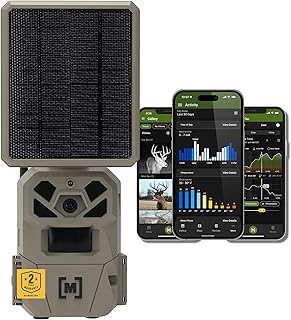
The Moultrie Edge Solar is made for hunters who want cellular scouting without constant battery swaps. It pairs an integrated solar panel with a removable lithium-ion battery, so it can stay on a remote ridge or river bottom and keep sending 40MP images and 1080p video through the mobile app on multi-carrier service. Night vision performance is steady and the platform is the same scout-from-anywhere system that makes managing several cameras simple. If you have a set-and-forget location that is hard to access, the solar charging design reduces trips in and keeps pressure low.
- Pro: Integrated solar with removable lithium-ion battery for extended field time
- Pro: App-based HD delivery with multi-carrier connectivity and reliable night vision
- Con: Solar charging still needs adequate sunlight and open canopy to perform best
Skip it if your best spots are in heavy timber shade or you prefer a fully non-cellular approach with no app or plan.
WOSODA Mini 4 Pack
The WOSODA Mini 4 Pack is built for hunters who need eyes on multiple trails, crossings, and field corners at once. These tiny 30MP, 1080P HD cameras include an SD card in the box and offer waterproof construction with motion-activated night vision and fast trigger response. Their small footprint is easy to conceal, which helps on public land or near high-traffic scrapes where theft and deer wariness are concerns. Hanging four locations for under the cost of two premium cellular units lets you learn property-wide movement quickly and then shift stands with confidence.
- Pro: Four tiny, easy-to-hide cameras with SD card included
- Pro: Cost-effective way to monitor several locations simultaneously
- Con: Non-cellular, so you must visit each camera to review footage
Skip it if you want remote image delivery or plan to run long video clips that demand heavier power and storage management.
TACTACAM Reveal X 3.0
TACTACAM Reveal X 3.0 is for hunters who want cellular intel with minimal setup hassle. It captures 4K photos and 1080p video, auto-connects to the strongest LTE carrier with multi-carrier support, and does not require an SD card, which simplifies card management. The housing carries an IP66 weather rating and night vision is consistent for identifying bucks at feeder and trail distances. With battery life rated at more than six months under typical use, it can stay out from early season through late season with fewer intrusions for maintenance.
- Pro: Auto-connect multi-carrier LTE with no SD card needed
- Pro: 4K photo quality and IP66-rated waterproof build with long battery life
- Con: Cellular features require ongoing data service to get full value
Skip it if you hunt areas with poor cell coverage or prefer a simple card-pull workflow with no subscriptions.
4 Pack Trail Camera (0.05s Trigger)
This 4 Pack Trail Camera package is about coverage and speed. The standout is a 0.05s trigger that helps freeze deer mid-step on fast trails, creek crossings, and pinch points where slower cameras often catch empty frames. You get night vision with motion activation and waterproof housings suited for season-long deployment, plus the flexibility of four viewpoints to triangulate travel direction and timing. For hunters who run a lot of cameras on new ground or want to monitor multiple access points around a bedding area, the speed and quantity are a practical advantage.
- Pro: Extremely fast 0.05s trigger for trails and crossings
- Pro: Four cameras to map movement across a property
- Con: Four-card management takes more time than app-based cellular systems
Skip it if you want instant phone delivery or hunt a single tight funnel where one premium camera is enough.
MagicEagle Cellular Solar
The MagicEagle Cellular Solar is the pick for hunters who want long-term, low-maintenance power with remote viewing. It combines a 13,000 mAh battery with a solar panel, 2K audible video, and no-glow IR night vision in an IP66 waterproof housing, and it connects over 4G for wildlife monitoring and home security use. The no-glow flash keeps deer calm after dark, while audible video adds context for behavior at scrapes and feeders. Rated 4.8 out of 5, it stands out for hunters who need extended uptime on distant farms or lease ground they cannot visit weekly.
- Pro: Large 13,000 mAh battery plus solar panel for extended operation
- Pro: No-glow IR and IP66 waterproofing with 2K video that includes audio
- Con: Larger solar setup is more visible and needs good sun exposure for best charging
Skip it if you need an ultra-compact, easily hidden camera or hunt mostly in dense canopy with limited sunlight.
Buying Guide
Trigger, Detection, and Placement
Trigger speed and detection angle matter more than raw resolution for deer hunting. On narrow trails and creek crossings, a faster trigger keeps the deer centered instead of half out of frame, while a wider detection zone helps at feeders and food plots. Set the camera at knee to waist height, angle it slightly down the trail rather than perpendicular, and clear grass that can cause false triggers in wind.
Flash Type and Night Image Quality
No-glow infrared is the stealthiest option for mature bucks and pressured ground, while low-glow gives slightly brighter night illumination with a faint visible glow. Look for clean, low-noise night images where you can see antler detail and body size without heavy whiteout on close subjects. Consistent exposure and quick recovery between night shots will tell you more than a spec sheet.
Power, Connectivity, and Weather Resistance
Decide early between cellular and traditional. Cellular saves trips and scent but needs signal and a data plan, and solar or high-capacity batteries extend time in the field. Traditional cameras are simpler and cheaper to run but require regular card pulls. Either way, demand true waterproof sealing, solid mounts that do not slip, and menus you can adjust with gloves.
Our Verdict
For most deer hunters, the MagicEagle Cellular Solar is the top pick because it balances long-run power with stealth and connectivity, offering a high-capacity battery plus solar, no-glow IR, IP66 waterproofing, and 2K video with audio for behavior clues. The budget pick is the WOSODA 2 Pack, which gives two dependable non-cellular cameras for less than a single premium unit and is perfect for learning new ground. If you need to run multiple cellular locations without buying piecemeal, the Moultrie Edge 3 two-pack wins when you want app-based scouting across two spots at once with multi-carrier coverage.
FAQ
Do I need a cellular trail camera for deer hunting?
Not always. Cellular cameras reduce pressure by limiting trips to pull cards and are ideal for distant or sensitive spots. If you hunt close to home and can check cards on a low-impact schedule, traditional cameras are simpler and have no ongoing costs.
Is no-glow really better than low-glow for mature bucks?
No-glow is invisible and less likely to alert wary deer, which helps on scrapes and near bedding. Low-glow can offer slightly brighter night images but may be noticed at close range, so choose no-glow when stealth is the priority.
Where should I hang a camera to pattern deer quickly?
Start with high-traffic features like pinch points, creek crossings, field entry trails, and community scrapes. Keep the camera about 3 to 4 feet high, aimed down the travel route, and avoid facing direct sunrise or sunset to reduce false triggers and washed-out images.
How do I get the most battery life in cold weather?
Use lithium batteries, limit long night video, lower the sensitivity in windy areas, and keep solar panels clear and sun-facing. Check mounts and seals before a cold snap so moisture does not drain power or fog the lens.


