Key takeaways
- Pro: Multi-carrier auto-connect simplifies setup in variable coverage and GPS helps map camera locations
- Pro: Strong value as a two-pack with sharp 40MP photos and 1080p video via the app
- Con: Low-glow flash is more visible than true no-glow and may be noticed on tight setups
After three seasons of running cellular cameras on a lease that gets no cell service at the gate and spotty coverage in the hardwoods, you learn quickly what actually matters. A good cellular trail camera has to send a usable daytime photo and a clean, identifiable nighttime image without blowing out eyes or missing the animal entirely, and it has to do it without needing you to walk in every week to swap cards or batteries. The worst ones look great on the box but fail on trigger consistency, app reliability, or the ability to hold a signal when the weather turns.
The difference between a keeper and a return comes down to how well the camera balances detection speed, image processing, carrier flexibility, and power management. The best models lock onto the strongest LTE signal automatically, deliver images fast enough to act on, and keep power draw low enough that you are not second-guessing every video clip. Cheap hardware often forces you to choose between image quality and battery life. The eight cameras below were evaluated on real field tradeoffs, not just spec sheets, to see which ones actually save you trips and give you scouting you can trust.
Our top picks
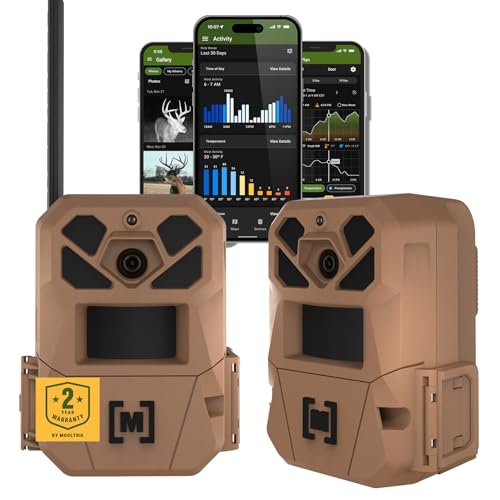 Moultrie Edge 3 Cellular Trail Camera
- EDGE 3 delivers real-time deer activity, movement patterns,…
- AI BUCK DETECTION + INSTANT ALERTS - Moultrie…
- Automatically connects to the strongest of four major…


As an Amazon Associate we earn from qualifying purchases at no extra cost to you.
Quick Picks
| Product | Best for | Price |
|---|---|---|
| Moultrie Edge 3 (2-Pack) | Best Two-Pack Value for Large Properties | $99 |
| SPYPOINT Flex-M Twin Pack | Best Budget Twin Pack for Beginners | under $90 |
| SPYPOINT Flex-M2 Twin Pack | Best Upgrade Twin Pack with 1080p Video | under $100 |
| TACTACAM Reveal X 3.0 | Best Solo Camera for Battery Life | under $100 |
| TACTACAM Reveal X Gen 3.0 (2-Pack) | Best Premium Two-Pack with GPS | under $200 |
| MagicEagle Solar 4G | Best Solar-Powered No-Glow Option | under $90 |
| SEHMUA 3rd Gen 4G LTE | Best for Live Streaming on a Budget | under $80 |
| SPYPOINT Flex-M (3-Pack) | Best Multi-Camera Coverage Kit | under $200 |
How We Picked
We ranked every camera on four field-relevant criteria: cellular reliability and carrier flexibility, image and video usability day and night, power system efficiency and weather resistance, and the overall ownership experience including app stability, setup time, and mounting versatility. Performance in low signal areas, true trigger responsiveness versus missed events, and whether night images were actually identifiable mattered more than inflated megapixel claims. Price and pack value were considered only after core field performance was established.
The 8 Best Cellular Trail Cameras in 2026
1. Moultrie Edge 3 Cellular Trail Camera (2-Pack)
The Moultrie Edge 3 is for hunters and land managers who want to cover two locations right out of the box without fussing with carrier selection. With auto-connect multi-carrier service, 40MP stills, 1080p video, and a low-glow flash with GPS tagging, it is built to scout from anywhere through the mobile app. The 0.5s trigger is responsive enough for trails and scrape lines, and the two-pack at this price makes it easy to run a primary and a secondary set.
- Pro: Multi-carrier auto-connect simplifies setup in variable coverage and GPS helps map camera locations
- Pro: Strong value as a two-pack with sharp 40MP photos and 1080p video via the app
- Con: Low-glow flash is more visible than true no-glow and may be noticed on tight setups
Skip it if you need absolute invisibility at close range or you primarily monitor over bait at very short distance where no-glow is critical.
2. SPYPOINT Flex-M Twin Pack
The SPYPOINT Flex-M Twin Pack is the easy entry point for anyone new to cellular cameras who wants no-WiFi operation and simple placement. It shoots 28MP photos and 720p video with sound, uses Dual-Sim LTE to find a usable signal, and carries an IP65 water-resistant build with GPS and night vision. Rated 3.9/5, it trades some video sharpness for affordability and reliable auto-connect performance.
- Pro: Dual-Sim LTE and GPS make deployment straightforward across different properties
- Pro: Twin pack pricing keeps cost per camera low for wider coverage
- Con: 720p video is softer than 1080p rivals and limits detail on distant subjects
Skip it if you plan to regularly pull video for antler scoring or need the clearest night video at longer range.
3. SPYPOINT Flex-M2 Twin Pack
The Flex-M2 Twin Pack is for the buyer who liked the original Flex-M concept but wants crisper video and higher still resolution. It steps up to 32MP photos and 1080p video while keeping Dual-SIM LTE, GPS tracking, and an IP65 weatherproof housing. You will still need to supply your own microSD card, and the twin pack again keeps the per-camera cost attractive for under $100 with a 3.9/5 rating.
- Pro: Meaningful bump to 1080p video and 32MP photos for better identification
- Pro: Retains automatic carrier switching and weather sealing for set-and-forget use
- Con: Requires a separate microSD card purchase and adds to initial cost
Skip it if you want a fully integrated no-card workflow or you need true no-glow rather than standard night vision illumination.
4. TACTACAM Reveal X 3.0
The TACTACAM Reveal X 3.0 is ideal for the solo hunter who values uptime over extras. It captures 4K photos and 1080p video, auto-connects to the strongest multi-carrier LTE signal, and needs no SD card, which streamlines setup. With IP66 protection and 6+ month battery life claimed, plus a pre-installed antenna and built-in GPS, it is designed to stay out longer with fewer service trips. Rated 4.4/5, it balances image flexibility and endurance well.
- Pro: No SD card needed and auto-connect LTE reduce field maintenance
- Pro: Long battery life and IP66 rating inspire confidence for remote ridges and bottoms
- Con: Single-camera kit is less economical than twin packs if you need broader coverage
Skip it if you need to run multiple units immediately and per-camera cost is your primary driver.
5. TACTACAM Reveal X Gen 3.0 (2-Pack)
This two-pack version of the Reveal X Gen 3.0 suits serious scouts who want matched cameras with consistent app control and power performance. You get the same multi-carrier HD photo and video system, pre-installed antenna, built-in GPS, low-glow flash, and the platform’s reputation for strong battery life and fast trigger response. The included cleaning cloth is a small but useful touch for lens upkeep. For under $200 and rated 4.3/5, it is a premium twin kit that prioritizes consistency.
- Pro: Matched pair ensures uniform image color and app behavior across locations
- Pro: Low-glow illumination with fast trigger helps catch quick trail crossings
- Con: Higher upfront cost than mixing budget single packs
Skip it if you only need one camera this season or you can tolerate more hands-on battery management.
6. MagicEagle Solar 4G
The MagicEagle Cellular Trail Camera is for users who want to minimize battery swaps and maximize stealth. It pairs a huge 13,000 mAh battery with a solar panel, offers 2K audible video, and uses no-glow IR for discreet night work with an IP66 waterproof rating. Finished in Army Green for natural concealment, it is positioned for wildlife monitoring and home security crossover use. With a 4.8/5 rating for under $90, it stands out for self-sustaining power.
- Pro: Integrated solar and large capacity battery extend time between service visits
- Pro: No-glow IR and 2K video with audio improve stealth and after-dark identification
- Con: Bulkier power assembly needs careful mounting and clear solar exposure to perform best
Skip it if your set is in heavy shade where solar gain is limited or you need the most compact form factor.
7. SEHMUA 3rd Gen 4G LTE
The SEHMUA 3rd Gen is built for the budget-conscious buyer who still wants modern cellular features, most notably 2K live streaming. It delivers 48MP photos, a built-in SIM with an unlimited data plan option, and a 4W solar powered system with no-glow flash and motion activation in a camouflage housing. Rated 4.9/5 and priced for under $80, it offers the lowest entry cost while pushing resolution and remote viewing higher than many rivals.
- Pro: Live streaming capability adds real-time scouting without a site visit
- Pro: Very aggressive price with high still resolution and included solar charging
- Con: Live streaming benefits depend heavily on signal strength and may be inconsistent in fringe coverage
Skip it if your location has marginal LTE or you prefer a proven multi-carrier auto-switching platform over built-in SIM flexibility.
8. SPYPOINT Flex-M (3-Pack)
The SPYPOINT Flex-M in a three-camera kit is for managers who need blanket coverage on a large parcel or multiple access points. Like its twin-pack sibling, it offers no WiFi needed operation, motion-activated night vision, Dual-Sim LTE, IP65 water resistance, 28MP photos, and 720p video with sound. Rated 3.8/5 and priced for under $200, the value is in deploying three units with one ecosystem and one app workflow rather than chasing peak per-camera specs.
- Pro: Three-pack simplifies wide-area surveys, trail networks, and food plot monitoring
- Pro: Dual-Sim LTE helps each camera independently find the best available network
- Con: 720p video and standard night vision are a step behind higher-resolution no-glow alternatives
Skip it if you need the sharpest video for long-range identification or you want true no-glow for close, pressured setups.
Buying Guide
Cellular Connection and App Experience
Carrier flexibility matters more than bars on your phone. Cameras with auto-connect multi-carrier or Dual-SIM LTE consistently get images out faster when one network is congested or terrain blocks a single tower. Look for in-app signal strength reporting, thumbnail-first delivery to save data, and reliable remote settings changes so you can adjust sensitivity or schedule without a hike. A stable app with timely notifications is worth more than a spec bump you will never see in the field.
Image Quality, Video, and Night Illumination
Daytime megapixels are less important than lens quality and processing, but higher still resolution does help with digital zoom on antlers. For video, 1080p or higher with audio captures behavior and direction of travel that a single frame misses. At night, low-glow gives slightly better range and brightness while no-glow stays fully covert at close range; pick based on deer pressure and camera distance. Check for balanced IR, not just range claims, so faces and racks remain identifiable rather than washed out.
Power, Durability, and Mounting
Cellular transmission is the biggest power draw, so efficient radios and solar support directly affect how long a camera stays active. Integrated solar with a large internal battery reduces swaps, but only if the panel gets adequate sun; otherwise, plan for external power or lithium cells in cold weather. Sealing matters: IP65 handles rain and dust, IP66 adds stronger water protection for exposed ridges. Favor cameras with sturdy mounts, easy leveling, and quick access to ports so you can service them quietly and leave minimal scent.
Our Verdict
For most hunters and property owners, the TACTACAM Reveal X 3.0 is the top pick because it removes friction: no SD card, auto-connect multi-carrier LTE, strong sealing, and the long battery life that keeps you out of the woods. If price per location is the priority, the SEHMUA 3rd Gen 4G LTE is the clear budget pick, pairing live streaming and 48MP capture with solar charging at the lowest price in the group. Choose the MagicEagle Solar 4G when stealth and self-sustaining power are paramount, especially for close sets over scrapes or security use where no-glow and 2K video pay off.
FAQ
Do cellular trail cameras need WiFi?
No. These cameras use LTE cellular networks to send photos and video to your phone. You only need adequate cell signal at the camera site and a data plan through the camera’s app or bundled SIM.
What is the difference between low-glow and no-glow?
Low-glow uses LEDs with a faint red visible flash that offers slightly better illumination range, while no-glow is invisible to the eye and more covert at close range. No-glow can sacrifice a bit of brightness, so choose based on deer pressure and distance to target.
How can I extend battery life on a cellular camera?
Use thumbnail delivery first, limit video length, lower the trigger sensitivity in high-traffic areas, and position solar panels for direct sun. Cold weather drains chemistry faster, so lithium or large-capacity solar systems help in winter sets.
Is live streaming worth it on a trail camera?
Live streaming is useful for checking conditions, confirming animal presence, or using the camera for security, but it depends on strong, stable LTE and uses more power and data. If your site has marginal signal, prioritize reliable image transmission over streaming features.