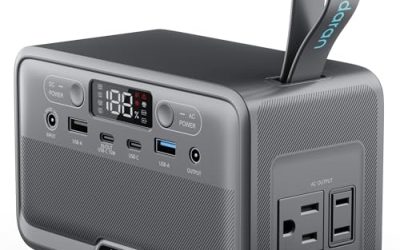
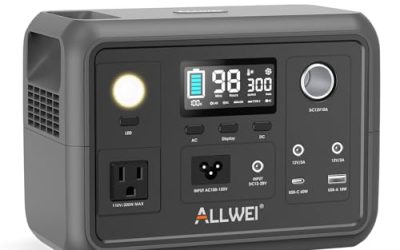
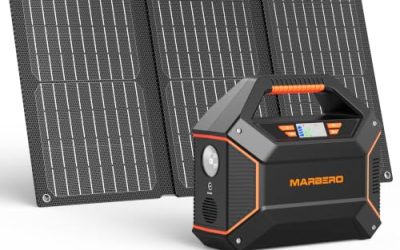
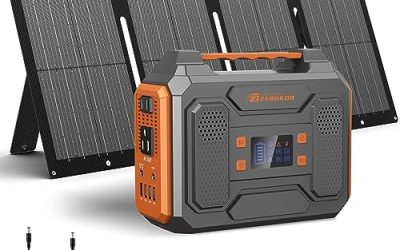
A portable power station is a battery, an inverter, and a charger in one box. It stores electricity, turns it into the same 120-volt AC power that comes out of your wall, and recharges from a wall outlet, a car, or a solar panel. Under $1,000, the market changed fast in 2026. A year ago that budget bought a good 1,000Wh station. In November 2026 it can buy a 2,048Wh station on sale — twice the capacity, with a stronger inverter, for the same money. Every price below was verified in November 2026. This guide covers eight stations we verified, from a $479 budget pick to 2,048Wh home-backup boxes, and explains exactly what each one runs, what it does not, and what the honest all-in cost is once you add a solar panel.
As an Amazon Associate, we earn from qualifying purchases made through links on this page, at no extra cost to you.
Quick Picks: The Best Portable Power Stations Under $1,000 at a Glance
| Station | Capacity | AC Output | Weight | Price (Nov 2026) | Best For |
|---|---|---|---|---|---|
| EcoFlow DELTA 3 Max | 2,048Wh | 2,400W | ~50 lb | $879 | Top pick — most power per dollar |
| Jackery Explorer 2000 v2 | 2,042Wh | 2,200W | 38.9 lb | $899 | Lightest 2,000Wh station |
| BLUETTI Elite 200 V2 | 2,073.6Wh | 2,600W | 53.4 lb | $899 | Lowest cost per watt-hour |
| EcoFlow DELTA 2 | 1,024Wh | 1,800W | ~27 lb | $899 | Fastest charging, biggest ecosystem |
| Anker SOLIX C1000 Gen 2 | 1,024Wh | 2,000W | ~28 lb | $549.99 | Best value 1,000Wh station |
| BLUETTI AC180 | 1,152Wh | 1,800W | ~35 lb | $769 | Tools and job sites |
| Jackery Explorer 1000 v2 | 1,070Wh | 1,500W | 23.8 lb | $799 | First-time buyers |
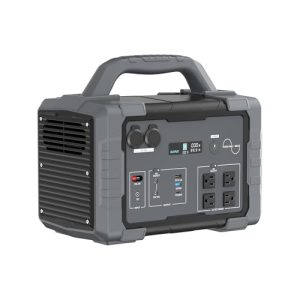
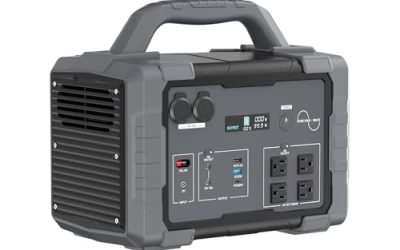
| EcoFlow DELTA 3 Classic | 1,024Wh | 1,800W | ~27.5 lb | $479 | Best budget 1,000Wh station |
Our Top Pick: EcoFlow DELTA 3 Max — $879
The EcoFlow DELTA 3 Max is the most station $1,000 buys in November 2026. Its catalog price at authorized retailers is $879 for 2,048Wh of LiFePO4 battery and a 2,400W continuous inverter that peaks at 3,400W with EcoFlow’s X-Boost mode. A 2,400W inverter with a 3,400W surge handles a full-size fridge (150–200W running, 600–800W at compressor start), a 1,200W microwave on its own, a CPAP all night, a laptop, a router, and lights — not all at once, but any sensible combination. In an outage, 2,048Wh keeps a fridge cold for roughly a day and a half. The catch is weight: at about 50 lb, this is a two-hand carry, with no wheels on the base unit.
Best Lightweight 2,000Wh: Jackery Explorer 2000 v2 — $899
The Jackery Explorer 2000 v2 holds the same 2,042Wh as our top pick, costs $899 in Jackery’s fall sale, and weighs just 38.9 lb — more than 11 lb lighter than the DELTA 3 Max. At 39 lb, one adult can carry it with one hand on the handle. At 50 lb, most people need two hands and a rest halfway to the tent. It has a 2,200W inverter with a 4,400W surge, a LiFePO4 battery rated for 3,000 cycles, and a clean interface that needs no app. The trade-offs are narrow but real: it is not expandable, so there is no extra battery to add later, and its 2,200W inverter is 200W weaker than the DELTA 3 Max. If you want the biggest battery you can still carry comfortably, this is the one.
Best Cost per Watt-Hour: BLUETTI Elite 200 V2 — $899
The BLUETTI Elite 200 V2 is the cheapest stored power in this guide: $899 for 2,073.6Wh works out to $0.43 per watt-hour, tied with our top pick and cheaper than every 1,000Wh station on a per-watt-hour basis. It also has the strongest inverter of any station here — 2,600W continuous — the longest warranty at five years, expansion to 8,192Wh with extra batteries, and up to 1,200W of solar input, the fastest solar refill in this guide. So why is it not the top pick? Weight and bulk. At 53.4 lb, it is the heaviest station in this guide, shaped like a small suitcase rather than a carry-on. It is a home-backup box that can go camping, not a camping box that can back up a home. If it will be carried, the Jackery wins.
Best Ecosystem and Fastest Charging: EcoFlow DELTA 2 — $899
The EcoFlow DELTA 2 is the veteran of this class, and it still earns its place. It holds 1,024Wh of LiFePO4 battery, delivers 1,800W continuous with a 2,700W surge, and recharges from a wall outlet to 80% in 80 minutes — the fastest wall charging in this guide. Its catalog price at authorized retailers is $899, though roundups in October and November 2026 found it between $599 and $799 on sale, and its list price is around $999. Its ecosystem is the deepest: extra batteries expand it to 3,072Wh, and its UPS mode switches over in under 30 milliseconds when the grid drops. The weakness is capacity for the money: $899 buys 1,024Wh here, while the same money buys 2,048Wh in the DELTA 3 Max.
Best Value 1,000Wh Station: Anker SOLIX C1000 Gen 2 — $549.99
The Anker SOLIX C1000 Gen 2 is the value pick of the 1,000Wh class. Its catalog price at authorized retailers is $549.99 in November 2026, while Anker’s own store lists it at $799 — a $249 gap that shows why you should check more than one seller before buying any power station. For that $549.99 you get 1,024Wh of LiFePO4 battery and a 2,000W inverter, stronger than the Jackery 1000 v2 and the DELTA 2, with a 2,400W surge. It weighs about 28 lb, accepts 600W of solar, and is rated for 3,000 cycles. Its warranty is five years, and an expansion port takes it to 2,048Wh with Anker’s extra battery. If your budget is $600 rather than $1,000, this is the station to buy.
Best for Tools and Job Sites: BLUETTI AC180 — $769
The BLUETTI AC180 is the rugged pick. Its catalog price is $769 at BLUETTI’s own store for 1,152Wh of LiFePO4 battery — the largest capacity of any 1,000Wh-class station here — and an 1,800W inverter with a 2,700W surge. That surge rating matters for tools: a circular saw or an angle grinder can draw two to three times its running wattage at startup, and the AC180’s 2,700W surge handles tools that trip weaker stations. It weighs about 35 lb, takes 500W of solar, and is rated for 3,500 cycles, the longest cycle life in this guide. The downside is charging speed: it takes about 2.5 hours to refill from the wall, roughly twice as long as the DELTA 2. For a home outage, where you may get a short window of grid power, it does.
Best for First-Time Buyers: Jackery Explorer 1000 v2 — $799
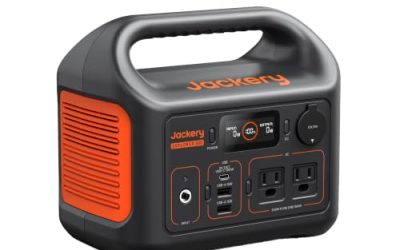
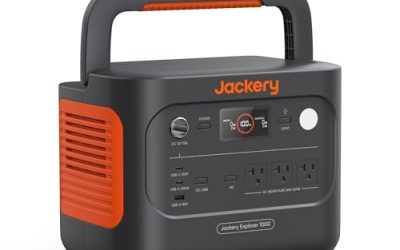
The Jackery Explorer 1000 v2 is the simplest station in this guide, and simplicity is a feature when you are buying your first one. It holds 1,070Wh of LiFePO4 battery, delivers 1,500W continuous with a 3,000W surge, and weighs 23.8 lb — the lightest station here. Its catalog price is $799 new, though roundups found it from $499 to $899 across sellers. It recharges from the wall in about 1.7 hours and takes 200W of solar. Its 1,500W inverter is the weakest in this guide, so it will not run a 1,800W hair dryer or a large microwave, but it runs a fridge, a CPAP, laptops, lights, and a small coffee maker without complaint. Buy it if you want the easiest station to live with and the lightest to carry. Buy the Anker C1000 Gen 2 if you want more inverter for less money.
Best Budget 1,000Wh Station: EcoFlow DELTA 3 Classic — $479
The EcoFlow DELTA 3 Classic is the cheapest honest 1,000Wh station in this guide. Its catalog price is $479 at authorized retailers in November 2026, with some listings at $429 and others at $502.88 — a tight range that suggests a real street price rather than a sale. For that money you get 1,024Wh of LiFePO4 battery, an 1,800W inverter with a 3,600W surge, 500W of solar input, and an IP65 dust-and-water-resistance rating that no other station here carries. It weighs about 27.5 lb and is rated for 3,000 cycles. Its 3,600W surge is the highest in the 1,000Wh class, which makes it the best budget pick for motor-driven loads like a fridge or a small air compressor. If $500 is your real ceiling, this is the station.
How to Choose: Capacity, Output, Battery Chemistry, Solar, and Weight
Capacity, measured in watt-hours, is how long the station runs. Divide the station’s watt-hours by the watts your device draws, then multiply by 0.85, because inverters lose roughly 15% converting DC to AC. A 1,024Wh station runs a 100W fridge for about 8.7 hours, a 60W CPAP for about 14.5 hours, and a 10W phone charger for days. Output, measured in watts, is what the station can run at once. Add up the running watts of everything you will plug in at the same time, then add the highest startup surge on top. A fridge that draws 150W running can surge to 800W when the compressor starts. A 1,500W inverter handles a fridge plus lights; it does not handle a fridge plus a 1,200W microwave. Battery chemistry is the most important spec in 2026. LiFePO4 (lithium iron phosphate) lasts 3,000–4,000 cycles to 80% capacity and handles heat better than older NMC (nickel manganese cobalt) cells, which last 500–800 cycles. Every station in this guide uses LiFePO4 except the Goal Zero Yeti 1000 Core, which still uses NMC — one more reason to skip it. Solar input decides how fast the station refills off-grid. A 500W solar input with a 400W panel refills a 1,024Wh station in about three hours of good sun; a 200W input takes a full day.
The Honest Budget: What $1,000 Really Buys in November 2026
A $1,000 budget buys more power station in November 2026 than it ever has, and the honest total is still higher than the sticker price. Our top pick, the DELTA 3 Max at $879, leaves $121. A 200W solar panel costs $150–$250, so a station-plus-panel kit runs $1,029–$1,129 — over budget. The Jackery Solar Generator 1000 v2 bundle, a 1000 v2 plus a 200W SolarSaga panel, is $879 in the catalog, which fits, but it is a 1,070Wh station, not a 2,000Wh one. All-in, a 1,000Wh camping station runs $660–$1,110 with a 200W panel and a bag. A 2,000Wh home-backup station runs $1,079–$1,299 all-in with a 400W panel array. Neither fits $1,000 with solar included. Two stations do not fit at all. The Goal Zero Yeti 1000 Core costs $999 at list — one dollar under the ceiling — for 983Wh of NMC battery, a 1,500W inverter, and a 9.5-hour wall charge. That is $1.02 per watt-hour, the worst rate in this guide, for a battery that lasts a sixth as long as LiFePO4. The Anker SOLIX C2000 Gen 2 is the borderline case: $999.99 at Anker, $749.99 at some retailers, for 2,048Wh and 2,400W. At the retailer price it is a genuine rival to our top pick; at Anker’s price it leaves one cent for a cable.
Traps to Avoid Before You Buy
The first trap is the junk price. Catalog searches for this guide returned an EcoFlow DELTA 2 at $35, a DELTA Pro at $125, a BLUETTI AC180 at $375, and a BLUETTI AC200L at $545.20. None of those prices is real. A DELTA 2 sells for $599–$899, a DELTA Pro for $2,000 or more, an AC180 for $499–$769, and an AC200L for $974.91 at authorized sellers. The second trap is the refurbished and marketplace listing. A Jackery Explorer 1000 v2 listed as refurbished at $799 is the same price as a new one — there is no discount, only a shorter warranty and a used battery. The third trap is the model-name maze. EcoFlow sells the DELTA 2, DELTA 3, DELTA 3 Classic, DELTA 3 Plus at $699, DELTA 3 Max, and DELTA 2 Max, all with similar names and different specs. The DELTA 3 Classic at $479 is not the DELTA 3 at $549–$599, and neither is the DELTA 3 Max at $879. The fourth trap is the bundle. A station-plus-panel bundle is only a deal if the panel is big enough to matter. Read the panel wattage, not the word “solar” in the title. The fifth trap is the watt-hour that is not there. The brands in this guide — EcoFlow, Jackery, BLUETTI, Anker — publish honest capacities that independent testers have verified. For a device that sits in your home with a large lithium battery inside, that track record is worth the premium.
Frequently Asked Questions
How long will a 1,000Wh power station run a fridge?
About 8–9 hours for a full-size fridge that draws 100W on average, using the 0.85 inverter-efficiency rule: 1,024Wh divided by 100W, times 0.85, is 8.7 hours.
Can a portable power station run a microwave or an air conditioner?
A microwave, sometimes. A 1,000W microwave draws 1,500–1,700W from the wall, so it needs a station with at least a 1,800W inverter and a 2,700W surge — the DELTA 2, DELTA 3 Max, AC180, and C1000 Gen 2 all qualify, but only on their own, with nothing else plugged in. A window air conditioner needs 2,400W or more to start, and a 2,048Wh battery runs it for barely an hour. A central air conditioner is beyond every station under $1,000.
Is LiFePO4 really better than NMC?
Yes, for this use. LiFePO4 lasts 3,000–4,000 charge cycles to 80% capacity, versus 500–800 for NMC, and it is more thermally stable, which matters in a hot garage or a sun-baked car.
Do I need a solar panel with my power station?
Only if you will be away from wall power for more than a day. A 1,024Wh station recharges from a wall outlet in 80 minutes to 2.5 hours, so for outage backup the wall is faster and cheaper than any panel.
How heavy is too heavy for a portable power station?
It depends on who carries it and how far. Under 25 lb, anyone carries it one-handed — the Jackery 1000 v2 at 23.8 lb is the only station here in that class. At 35–40 lb, one strong adult carries it comfortably; the Jackery 2000 v2 at 38.9 lb is the sweet spot for a 2,000Wh station. If the station will move between a car and a campsite more than once a day, weight matters more than capacity.
FAQ
How long will a 1,000Wh power station run a fridge?
Can a portable power station run a microwave or an air conditioner?
Is LiFePO4 really better than NMC?
Do I need a solar panel with my power station?
How heavy is too heavy for a portable power station?
More from Amazon
Programs that pair well with the guide above. Offers and eligibility are set by Amazon and may change.
Free shipping on eligible items, Prime Video and more. Eligible new members can start with a free trial.
Start a Prime free trialA Prime membership for ages 18-24 with a trial period. Eligibility is set by Amazon.
See Prime for Young AdultsAudiobooks and podcasts to listen to on the go. Eligible new members can start with a free trial.
Try Audible freeAd-free music streaming. Eligible new subscribers can start with a free trial.
Try Music Unlimited freeAs an Amazon Associate we earn from qualifying purchases.