Key takeaways
- A teak cutting board is the single most overlooked upgrade in a home kitchen. You spend a decent amount on knives, but a warped, splintering, or absorbent board quietly dulls those edges and harbors bacteria in every micro-crack. Teak solves…
A teak cutting board is the single most overlooked upgrade in a home kitchen. You spend a decent amount on knives, but a warped, splintering, or absorbent board quietly dulls those edges and harbors bacteria in every micro-crack. Teak solves both problems because of its high natural oil content and tight grain structure, but not every board made from teak performs the same. Thickness, grain orientation, and finish type all affect how the surface holds up over years of heavy use.
We compared the current Teakhaus lineup across published dimensions, thickness, oil finish type, and what long-term owners report in reviews. The differences between these models come down to intended task (general prep versus carving), size relative to your counter space, and whether you want the extra security of a juice groove. The eight options below cover every realistic kitchen scenario, from a small apartment to a household that roasts a whole turkey weekly.
Our top picks




As an Amazon Associate we earn from qualifying purchases at no extra cost to you. Ratings are shown as listed on Amazon.
Quick Picks
| Product | Best for | Price |
|---|---|---|
| XL Teak Wood Cutting Board | Large-countertop prep and bread-making | under $150 |
| Carving Board with Juice Groove – M | Weeknight roasts and small poultry | $55 |
| Large Teak Wood Cutting Board | Daily chopping on mid-size counters | $108 |
| Teak Wood Cutting Board Set of 3 | Gift-giving and task separation | n/a |
| Carving Board with Juice Groove – L | Sunday roasts and whole chickens | under $100 |
| Butcher Block Carving Board | Heavy-duty meat prep with end-grain benefits | $75 |
| Carving Board with Juice Groove – XL | Thanksgiving and large-batch cooking | under $150 |
| Carving Board with Juice Groove – S | Tight counters and quick tasks | $44 |
How We Picked
Three criteria separate a good teak board from a forgettable one: surface durability (thickness and grain orientation determine whether the board resists warping), knife friendliness (end-grain and proper oil finishes preserve edges better than hard, sealed surfaces), and practical size-to-workflow fit (a board that is too large for your counter or too small for your protein wastes both space and function). We also weighted whether the finish requires more or less maintenance and whether FSC certification matters to your household values, which Teakhaus covers across every model.
The 8 Best Teakhaus Cutting Board in 2026
Teakhaus XL Teak Wood Cutting Board
This is the board for someone who bakes bread, stretches pizza dough, or handles sheet-pan quantities of vegetables. At 24 by 18 inches and a full 1.5 inches thick, it doubles as a serving platter for a charcuterie spread without looking out of place. Owners consistently praise the stability on slick countertops and the way the natural oil finish deepens in color over time without feeling greasy. The XL footprint is genuinely large, so measure your available counter before committing. Skip it if your kitchen is compact or if you mainly need a carving surface for proteins; the juice groove models handle that better.
Teakhaus Carving Board with Juice Groove – Medium
The medium carving board sits in a sweet spot for households that cook a whole chicken, a pork loin, or a small roast most weeks. At 18 by 14 inches and 1 inch thick, it stores flat in a drawer with less effort than the thicker options. Owners appreciate the lightweight feel and the fact that the beeswax oil finish smells faintly pleasant when you first unbox it. The one drawback reported repeatedly is that 1 inch of teak can show shallow knife marks faster than the 1.5-inch siblings under heavy cleaver use. Skip it if you regularly break down whole hogs or work with a meat mallet.
Teakhaus Large Teak Wood Cutting Board
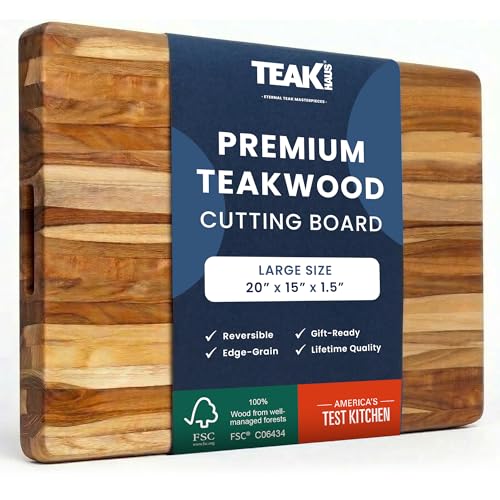
This is the do-everything daily driver for most kitchens. Twenty inches by fifteen is big enough to chop a head of cabbage without debris flying off the edges, and the 1.5-inch thickness gives it heft that resists sliding even on glass or laminate counters. The natural oil finish is the same as the XL model and ages well with monthly re-oiling. Owner feedback highlights the clean, minimalist look that photographs well for food content. The main downside is that at $108, it costs nearly double the medium carving board without adding a juice groove, so it is less specialized for roasting tasks. Skip it if your primary need is carving and liquid containment.
Teakhaus Teak Wood Cutting Board Set of 3
A set covering small, medium, and large means you can dedicate one board to raw proteins, one to produce, and one to bread or serving without cross-contamination worries. The edge-grain construction is reversible, so each board has a longer service life before either face shows wear. Reviewers frequently mention the gift-ready packaging makes this an easy choice for housewarmings or holiday giving without extra wrapping effort. The limitation is that edge-grain boards are marginally harder on knife edges than end-grain alternatives, and the set price is not fixed on most listings. Skip it if you already own one reliable board and need only a carving surface.
Teakhaus Carving Board with Juice Groove – Large
Twenty by fifteen with a 1.5-inch thickness and a single perimeter juice groove makes this the workhorse for anyone who roasts a bone-in rib or a whole turkey on a regular basis. The beeswax oil finish provides a slightly warmer tone and, according to owners, is easier to touch up than pure mineral oil because it bonds more tenaciously to the grain. The extra half-inch of thickness compared to the medium model pays off when you are separating heavy joints and applying downward pressure with a carving fork. Skip it if your oven rarely sees anything larger than two chicken thighs.
Teakhaus Butcher Block Carving Board
End-grain construction means the knife edge slides between wood fibers rather than pressing against them, which is why butchers and chefs have preferred end-grain for generations. At $75, this is the most affordable entry into that construction style in the Teakhaus range. The juice groove and medium thickness make it suitable for both carving and light prep. Owner feedback notes the weight feels reassuring during aggressive knife work, though some mention that end-grain boards require more frequent oiling to prevent the small exposed fibers from drying. Skip it if you want the absolute lowest-maintenance finish available.
Teakhaus Carving Board with Juice Groove – Extra Large
If you host a full Thanksgiving or Christmas dinner for ten-plus people, the 24 by 18 carving surface prevents the awkward two-stage transfer from board to platter that smaller models force. The 1.5-inch thickness with a beeswax oil finish is the same construction used on the XL prep board, adapted for liquids. Owners who cook for crowds describe it as the single board that eliminated kitchen chaos during holiday cooking. The tradeoff is obvious: it is heavy to store, hard to fit in a sink for washing, and the most expensive teak carving board in the lineup. Skip it if you carve for four or fewer.
Teakhaus Carving Board with Juice Groove – Small
At 14 by 10 inches and 1 inch thick, this is the board for apartment kitchens, dorm setups, or anyone who wants a dedicated surface for quick proteins like steaks, chops, or fish fillets without hauling out anything larger. The beeswax finish and FSC certification match the rest of the line. Owners praise how easily it fits under a cabinet shelf or in a dish rack, calling it the most practical single-purpose board for weekday dinners. The limitation is that it is too small for anything with a bone structure, and the thin profile can shift slightly during forceful cuts. Skip it if you need one board to cover every task in your kitchen.
Buying Guide
Thickness and Grain Orientation
A 1-inch board stores easily but marks faster under pressure. The 1.5-inch models resist warping and feel anchored during carving or heavy chopping. Edge-grain boards present a harder surface to the knife, while end-grain construction (the Butcher Block model) self-heals and extends blade life. If you keep sharp European-style chef knives, end-grain is the friendlier choice. If you mostly work with produce and bread, edge-grain or flat teak is sufficient.
Juice Groove vs. Open Surface
A perimeter juice groove is a functional feature, not a cosmetic one. It contains rendered fat, blood, and marinades on a single plane so liquids do not pool across your counter. The tradeoff is that grooves are harder to clean by hand, and some owners use a small brush to keep the channel clear. If you cook mostly vegetables or bread dough, an open surface like the XL or Large prep boards is easier to wipe down and offers more usable area.
Oil Finish Type and Maintenance
Teakhaus uses two finishes: natural oil (mineral-based) and beeswax oil. Both are food-safe and enhance teak’s inherent water resistance. Owners report that beeswax finishes need slightly less frequent reapplication because the wax component seals the surface against moisture penetration for a longer window. Whichever you choose, a monthly coat of the recommended conditioner keeps the board from drying and cracking over time, regardless of size.
Our Verdict
For most home cooks who want a single teak board that handles daily prep without fuss, the Large Teak Wood Cutting Board at $108 is the top pick. Its 1.5-inch heft and generous surface make it versatile enough for everything except roasting. For a focused budget entry that still delivers real carving function, the Small Carving Board with Juice Groove at $44 is the best value. However, if you cook large-format proteins weekly, the Large Carving Board for under $100 wins because it combines the groove and the thickness at a price that undercuts the XL by a meaningful margin.
FAQ
Are Teakhaus boards safe for knives?
Yes. Teak sits at a moderate hardness on the Janka scale, which means it offers enough give to preserve a factory edge longer than glass or stone surfaces. End-grain models are gentler still because the blade separates fibers rather than striking them.
How often should I oil my teak cutting board?
Once a month under normal home use is sufficient for most owners. If you wash it by hand daily and it lives in a dry climate, every three weeks keeps the surface sealed and prevents the pale, dry patches that signal moisture loss.
Can I put a teak board in the dishwasher?
No. Prolonged water exposure and high heat will cause even teak to check, warp, or delaminate at the glue lines. Hand-wash with warm water and a small amount of soap, then dry upright to extend the board’s life.
What does FSC certification actually mean here?
FSC certification confirms that the timber was harvested from a forest managed to meet environmental and social standards set by the Forest Stewardship Council. For Teakhaus, this means the wood is traceable to responsibly managed plantations rather than cleared natural forest.