A pair of binoculars can turn a hiking trail, a stadium seat, or a backyard into something genuinely worth looking at. But the market is flooded with listings that look identical—magnification numbers in bold font, “HD” stamped on every thumbnail—and most buyers end up guessing which pair actually delivers a sharp, bright image at a fair price. The problem is not that there are too few options; it is that the specs on paper rarely tell you whether the optics will hold up in real use.
This binoculars buying guide cuts through that noise by comparing published specifications, street prices, and recurring themes in owner feedback across eight models that dominate the value segment heading into 2026. What separates a worthwhile pair from a disappointing one comes down to a handful of tangible factors: lens coating quality, real-world exit pupil size, body durability, and whether the magnification claimed actually matches the field of view you get when you look through them. None of these products break the bank, and that is exactly the point—getting a solid image does not require spending hundreds.
Our top picks




As an Amazon Associate we earn from qualifying purchases at no extra cost to you.
Quick Picks
| Product | Best for | Price |
|---|---|---|
| Occer 12×25 Compact | Families who want one pair for adults and kids | under $40 |
| 20×50 High Powered (Waterproof, Gift Listing) | Stargazing and long-range observation on a budget | under $30 |
| Compact HD Mini Folding | Concerts, theater, and pocket-carry travelers | under $20 |
| 20×50 High Powered (Waterproof, Sport Listing) | Football games and cruise decks | under $30 |
| Vortex Triumph HD 10×42 | Birdwatching and general outdoor use with a warranty | $99 |
| 15×52 HD with Phone Adapter | Smartphone digiscoping and wildlife photography | under $70 |
| Hontry 10×25 Compact | Kids and lightweight day hikes | under $30 |
| POLDR 12×25 Small Pocket | Everyday carry for trailheads and bleachers | under $20 |
How We Picked
We focused on four criteria that consistently predict satisfaction in this price range: optical coherence at the claimed magnification (do owners report a sharp center with soft edges, or uniform clarity?), build quality relative to cost (hinge tightness, rubber armor, fogging complaints), portability (weight and folded dimensions versus the stated use case), and price-to-performance ratio compared to direct competitors. We cross-referenced spec sheets against patterns in owner reviews to flag listings where the magnification or objective diameter numbers look impressive but real-world brightness and field of view fall short of what those figures imply.
The 8 Best Binoculars Buying Guide in 2026
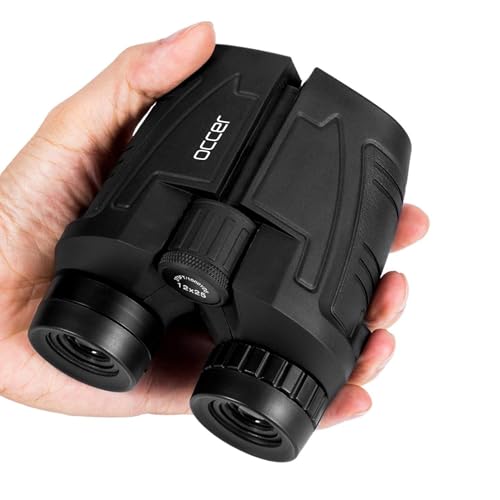
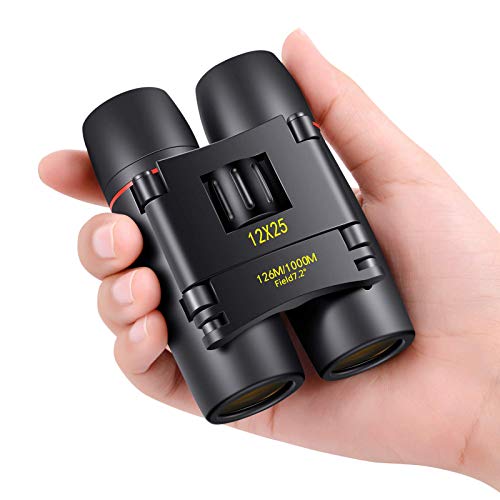
Occer 12×25 Compact Binoculars for Adults and Kids
This is the most common first recommendation in family-oriented binoculars buying guide discussions, and it earns that spot. The 12×25 configuration strikes a workable balance: enough reach to identify birds at moderate distance without the shake that higher magnification introduces. Owners praise the multi-coated optics for color accuracy and note the included neck strap and carrying case as genuine value adds. The grip texture is secure even with damp hands, and the diopter adjustment ring has clear markings.
- Pros: Consistent center sharpness at 12x, complete accessory kit at this price
- Con: Eye relief is modest, making it awkward for eyeglass wearers at full extension
Skip this if you primarily watch birds at long range or need generous eye relief for glasses.
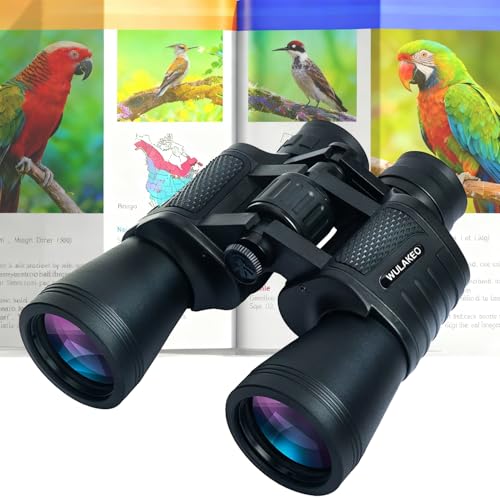
20×50 High Powered Binoculars (Waterproof, Gift Listing)
At 20x magnification through 50mm objectives, this pair delivers a genuinely large exit pupil that stays bright even as the sun drops. Owners cite low-light performance as the standout feature for dawn birding and evening stargazing sessions. The waterproof sealing gets repeated mentions without complaints in early-use reviews. The phone adapter is sometimes bundled; check the specific listing. The rubber armor absorbs knocks well.
- Pros: Bright image in dim conditions, sealed body resists moisture
- Con: 20x demands a steady hand or a tripod adapter; handheld shake is pronounced
Pass if you need quick target acquisition while moving through brush or bleachers.
Compact HD Mini Folding Binoculars
Under seventeen dollars for a folding pair that fits a jacket pocket is a genuine bargain, and owners confirm the optics punch above their price. The 8×21 range is forgiving of hand movement, which makes these ideal for concerts and theater where a small, quiet pair matters more than reach. The folding hinge stays firm after months of use according to repeat purchasers. Weight is the killer advantage here—these disappear into a bag.
- Pros: Extremely light, folds flat, reliable at close-to-mid range
- Con: Not bright enough for anything beyond well-lit daytime or indoor venues
Not for you if outdoor low-light or distant wildlife viewing is the priority.
20×50 High Powered Binoculars (Waterproof, Sport Listing)
Nearly identical in specs to the gift-listing version above but at a slightly lower street price, this variant leans into sport use. Owners highlight the focus wheel travel: it is wide enough to lock onto fast-moving subjects like football players without hunting. The 50mm objectives keep the image usable during overcast afternoon games. Some reviews note the prism alignment can arrive slightly off, requiring a minor factory-fault return.
- Pros: Fast focusing range, waterproof body for under $21
- Con: Occasional QC variance on prism alignment from factory
Consider stepping up if you want a consistent brand warranty across units.
Vortex Triumph HD 10×42 Binoculars
This is the only name-brand model on the list, and it justifies the price jump. Vortex offers a lifetime warranty that covers accidental damage, which is rare at any price. Owners consistently describe the image as clean from edge to edge at 10x, with true-to-life color rendering that the cheaper pairs cannot match. The 42mm objectives give a 4.2mm exit pupil, bright enough for most dawn and dusk scenarios. The roof prism design makes them more compact than comparable porro models.
- Pros: Edge-to-edge clarity, lifetime transferable warranty, compact roof prism form
- Con: Triple the cost of other entries in this roundup
Skip only if your budget is genuinely under $50 and warranty is irrelevant to your use.
15×52 HD Binoculars with Upgraded Phone Adapter
The bundled phone adapter is the selling point, and owners who use digiscoping confirm it holds steady enough for smartphone captures at 15x. The 52mm objectives push the exit pupil to a generous size, which keeps the image bright during golden-hour wildlife sessions. Field of view is narrower than 10x models, so target acquisition takes practice. Build is solid with a metal hinge.
- Pros: Included adapter enables phone photography, large objectives for dim light
- Con: Heavy for extended handheld use; best paired with a monopod
Not ideal if you want a grab-and-go pair that lives in a coat pocket.
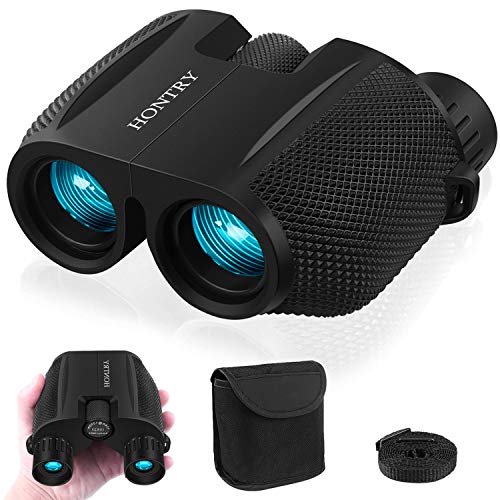
Hontry 10×25 Compact Binoculars
A reliable middle option for anyone who wants compact size without the compromises of the folding micro models. Ten times magnification is the sweet spot for most outdoor use, and the 25mm objectives produce an exit pupil of 2.5mm—adequate for daylight and tolerable at dusk. Owners report smooth focus action and a comfortable grip that smaller pairs sometimes lack. The price positions it well between the premium and budget tiers.
- Pros: Comfortable 10x magnification, solid focus mechanism, kid-friendly weight
- Con: Eye relief is limited for glasses wearers
Look elsewhere if you need waterproofing for rain-heavy environments.
POLDR 12X25 Small Pocket Binoculars
At twenty dollars, this pocket pair offers the same 12x magnification as the Occer above but at a lower cost. The trade-off appears in build materials: owners note a slightly plasticky feel on the eyecups and focus ring. Optics are serviceable for casual trail use and stadium seating. The compact form factor makes it a true grab-and-go option that survives a backpack bottom without a case.
- Pros: Lowest price with 12x magnification, compact and lightweight
- Con: Eyecup durability is the most common complaint
Not for you if you need a pair that will survive years of daily outdoor abuse.
Buying Guide
Magnification and Steadiness
Higher magnification is not automatically better. Above 10x, handheld shake becomes visible and can make tracking moving subjects frustrating. The general rule: stay at 8x or 10x for active outdoor use like hiking and birding; consider 12x to 15x when you will have a stable surface or monopod; reserve 20x for stationary observing where you can brace or mount the binoculars. Field of view narrows as magnification increases, so a 20x pair might show you a fraction of what a 10x pair reveals at the same distance.
Objective Lens Diameter and Exit Pupil
Divide the objective diameter by the magnification to get the exit pupil. A 50mm objective at 10x yields a 5mm exit pupil, which fills your dilated eye in low light and produces a bright image. A 25mm objective at 12x gives roughly 2mm—sufficient in daylight but noticeably dim at dawn. The human eye dilates to about 7mm in darkness, so exit pupils below 3mm will feel limited when the light drops. This single calculation matters more than any marketing term on the box.
Coatings and Light Transmission
Multi-coated lenses transmit more light than uncoated or single-coated glass, which translates directly to a brighter, higher-contrast image. Look for the term “fully multi-coated” on the spec sheet rather than just “multi-coated,” which may mean only one surface per lens element has a coating. Phase-coated roof prisms are the premium-tier feature to seek if you want true color fidelity without paying flagship prices; at the budget tier, multi-coated porro prisms often deliver comparable brightness at lower cost.
Our Verdict
The Vortex Triumph HD 10×42 is the overall top pick: the lifetime warranty, edge-to-edge image quality, and compact roof prism design justify every extra dollar. For the best value under $40, the Occer 12×25 remains the standout—it covers the widest range of use cases at a price that is genuinely accessible. If low-light observation or stargazing is your specific priority, the 20×50 waterproof model for under $30 is the one to choose over everything else on this list, provided you accept the steadiness requirement that comes with that magnification.
FAQ
What is the difference between porro and roof prism binoculars?
Porro prisms are older technology that uses offset tubes and a zigzag light path, generally producing a wider field of view and greater depth perception at lower cost. Roof prisms align the objective and eyepiece in a straight line, making the body more compact and easier to waterproof, though quality coatings are essential to match porro brightness. Budget porro pairs often outperform budget roof pairs optically; premium roof pairs outperform premium porro pairs in build and portability.
Do binoculars need to be waterproof for bird watching?
Not strictly. A pair labeled “waterproof” uses O-ring seals and nitrogen purging to prevent internal fogging and water ingress. For occasional use in light drizzle, a standard pair is fine. For daily use across seasons, early mornings with heavy dew, or coastal environments, the sealing is a meaningful durability investment rather than a marketing gimmick.
How do I fix blurry binoculars that were sharp on one side?
Start by adjusting the diopter ring on the eyepiece that looks blurry. Set the main focus wheel to a distant target, close one eye, focus with the other, then adjust the diopter until that second image is equally sharp. If the blur persists after diopter adjustment, the prism alignment may be off, which warrants a return or warranty claim rather than a repair attempt.
Is 12×25 better than 10×42 for long-distance viewing?
12x provides more reach, which helps with distant subjects. However, the 42mm objective gathers significantly more light than 25mm, producing a brighter and more comfortable image in anything less than direct midday sun. For a dedicated long-range viewing session in good light, 12x wins. For all-day versatility including dawn and dusk, 10×42 is the better general-purpose choice despite the lower magnification.