Key takeaways
- Ground anchors: Choose anchors designed for the soil and frame, then verify that they are installed as instructed. A heavy frame can still tip if it is not secured.
- Guardrails and barriers: Raised platforms should have protective barriers with openings that do not create head or body entrapment hazards.
- Covered hardware: Caps or recessed bolts reduce snagging and protect children from protruding threads.
- Non-slip steps: Grooved ladders and climbing holds are preferable to smooth boards, particularly after rain.
- Flexible swing connections: Heavy-duty chains or coated ropes should move freely without sharp links, fraying, or pinch points.
- Impact-absorbing surfacing: Install an appropriate playground surface, such as engineered wood fiber, rubber mulch, or a compliant synthetic surface. Grass and ordinary soil are not reliable fall protection.
The best swing sets for most backyards are a wood or metal set sized for your children’s current ages, with at least a 6-foot safety zone, a published weight rating, and room to grow; the right choice depends more on footprint and installation than on the number of accessories.
Best swing sets by backyard situation
| Best for | Recommended set type | Typical footprint | Typical total capacity | Expected assembly time |
|---|---|---|---|---|
| Small yard or townhouse | Compact metal A-frame with two swings | 8–12 ft wide by 7–10 ft deep | 400–600 lb | 2–4 hours |
| Preschool children | Low wood or metal set with belt swings and short slide | 10–14 ft by 10–14 ft | 600–800 lb | 4–8 hours |
| Several children | Heavy-duty wood playset with three-position swing beam | 14–20 ft by 12–18 ft | 800–1,200 lb | 8–16 hours |
| Older children | Tall wood or steel set with climbing wall, monkey bars, and longer slide | 16–24 ft by 14–20 ft | 900–1,500 lb | 10–20 hours |
| Lowest maintenance | Powder-coated steel swing set | 8–16 ft by 7–14 ft | 400–1,000 lb | 2–6 hours |
These are useful planning ranges rather than specifications for one particular model. Always use the manufacturer’s dimensions and weight ratings when comparing a specific set.
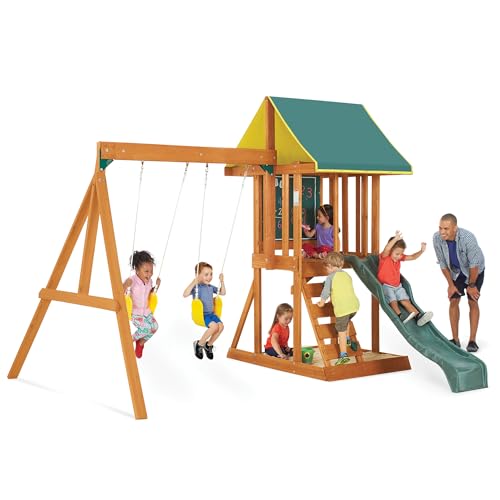
KidKraft Appleton Wooden Swing Set, (Amazon Exclusive)
Included for 'Best Swing Sets for Backyard Playgrounds' because the listing specifies (Amazon Exclusive), details this guide uses to compare options.
View on Amazon
Sportspower Arcadia Metal Swing Set for Kids – Trapeze, 2-Person Glider, 5ft Slide, Anchor Kit, 6.1ft Durable Steel Frame – Outdoor Backyard Playset with 600 lbs Capacity
Included for 'Best Swing Sets for Backyard Playgrounds' because the listing specifies Trapeze and 2-Person Glider, details this guide uses to compare options.
View on Amazon
Sportspower Park Ridge Metal Swing Set for Ages 3-8, 2 Swings, Standing Swing, Roman Glider, Teeter Totter, on 5ft Slide, 6.1ft Durable Steel Frame, Anchor Kit, 800lbs
Included for 'Best Swing Sets for Backyard Playgrounds' because the listing specifies 2 Swings and Standing Swing, details this guide uses to compare options.
View on Amazon
Backyard Discovery Mount Mckinley Cedar Wood Swing Set with Wave Slide, Play Deck, Double Rock Wall, Rope Ladder, Web Swing, Belt Swings, Toy Telescope, Steering Wheel, Sandbox Area, Outdoor Playset
Included for 'Best Swing Sets for Backyard Playgrounds' because the listing specifies Play Deck and Double Rock Wall, details this guide uses to compare options.
View on AmazonOur top picks by design
Best overall: a modular wood playset with a three-position swing beam
For families with children from roughly 3 to 10 years old, a modular wood playset offers the broadest mix of play value. Look for two belt swings, one trapeze bar or toddler-compatible swing position, a raised deck, a slide, a ladder, and a climbing feature. Established wood-playset brands such as Backyard Discovery and Gorilla Playsets offer this general format in multiple sizes.
The advantage is longevity: young children can use the lower ladder and gentle slide, while older children move toward the climbing wall, upper deck, and monkey-bar accessories. The drawback is ownership work. Wood needs periodic inspection, bolt tightening, cleaning, and—depending on the finish and climate—stain or sealant maintenance.
Best for small spaces: a compact metal A-frame
A metal A-frame is the sensible choice when the swing experience matters more than a playhouse, sandbox, or large slide. Many compact designs fit in a roughly 10-by-10-foot area before the required safety clearance is added. They are also easier to assemble than large wooden forts and can often be moved by two adults.
Choose a model with a wide, braced base, powder-coated tubing, adjustable ground anchors, and swing seats that can be replaced. Metal is less vulnerable to rot, but exposed steel can rust where the coating is scratched. Check welds and fasteners at the start of every season.
Best for low maintenance: a galvanized or powder-coated steel set
Steel is a strong option for families who do not want to stain a wood frame. Galvanized steel has a protective zinc coating, while powder-coated steel uses a baked-on finish over the metal. Both can last well outdoors when water cannot collect inside the tubing and the frame is properly anchored.
Steel sets commonly provide less enclosed play space than wood forts. They may also transmit more movement through the frame, so a larger model should have substantial braces and a clearly stated maximum occupancy. Avoid judging strength by tube diameter alone; the joint design, anchor system, and published rating matter just as much.
Best for toddlers: a low-rise set with age-appropriate seats
For children around 2 to 5 years old, prioritize a low platform, short slide, easy-grip ladder, and full-support belt or bucket swings. A toddler set should not simply be a scaled-down version of a tall set: high decks and open climbing walls create challenges that younger children may not be ready to manage independently.
Some wooden sets from brands such as Step2 and Backyard Discovery include toddler-friendly layouts, but age labels vary. Confirm the minimum age for every component, not just the overall product. A set can be suitable for a 3-year-old at the slide while its trapeze bar is intended for older children.
Head-to-head: wood versus metal
| Consideration | Wood frame | Metal frame |
|---|---|---|
| Typical working life | About 8–15 years with maintenance and suitable drainage | About 8–15 years when coating and joints remain intact |
| Maintenance | Inspect for splinters, rot, cracks, and loose hardware; reseal as needed | Inspect for rust, coating damage, bent parts, and loose joints |
| Play features | Usually better for forts, roofs, sandboxes, and climbing walls | Usually better for swings, rings, gliders, and compact layouts |
| Assembly | More parts and longer assembly, often 6–20 hours | Usually fewer structural parts, often 2–8 hours |
| Common failure point | Water trapped at the ground contact or under untreated joints | Rust at scratches, welds, hollow-tube openings, and fasteners |
How much space do you really need?
Do not measure only the frame. A swing set needs an unobstructed use zone around it. A practical planning rule is to allow at least 6 feet around the structure and more in front of swings and slides. For example, a frame measuring 12 feet wide by 10 feet deep may need a planning area of approximately 24 feet by 22 feet once clearance is included.
A swing’s travel can extend farther than the frame. If the swing beam is 8 feet high, place the set so the front and rear swing paths do not face a fence, tree trunk, retaining wall, or parked vehicle. Use the manufacturer’s required clearance when it exceeds this rule of thumb.
Safety features worth paying for
- Ground anchors: Choose anchors designed for the soil and frame, then verify that they are installed as instructed. A heavy frame can still tip if it is not secured.
- Guardrails and barriers: Raised platforms should have protective barriers with openings that do not create head or body entrapment hazards.
- Covered hardware: Caps or recessed bolts reduce snagging and protect children from protruding threads.
- Non-slip steps: Grooved ladders and climbing holds are preferable to smooth boards, particularly after rain.
- Flexible swing connections: Heavy-duty chains or coated ropes should move freely without sharp links, fraying, or pinch points.
- Impact-absorbing surfacing: Install an appropriate playground surface, such as engineered wood fiber, rubber mulch, or a compliant synthetic surface. Grass and ordinary soil are not reliable fall protection.
Keep swings separated from walls, fences, and other play features. Inspect the set before each use for loose fasteners, damaged seats, splinters, cracked plastic, and exposed concrete or anchor hardware.
Assembly and ownership costs
Assembly time is often underestimated. A compact metal set may take two adults three hours, while a roofed wood playset can require a full weekend. Add time for leveling the site, installing anchors, spreading surfacing, and disposing of packaging. A level base is not cosmetic: a tilted frame changes swing motion and puts uneven stress on joints.
Use a worked example when comparing value. Suppose a $900 set is used four times per week for five years:
4 uses × 52 weeks × 5 years = 1,040 uses. The equipment cost is approximately $0.87 per use before surfacing, maintenance, and installation. If the set is used only once a week, the same calculation produces 260 uses, or about $3.46 per use. Frequency of use can matter more than a modest difference in purchase price.
Budget separately for safety surfacing, which may cost roughly $200–$1,000 or more depending on the area and material. Replacement swing seats, ropes, hardware, and plastic slides are normal ownership expenses. Keep the manual and parts list; finding a matching bolt or seat several years later is much easier with the original information.
What to check before buying
- Measure the available area, then mark the full clearance zone with string or chalk.
- Check the minimum and maximum age for each accessory.
- Compare the weight limit of each swing position with the combined weight of likely users, not just one child.
- Confirm whether anchors, surfacing, and assembly are included or separate.
- Look for replacement parts and a readable maintenance schedule.
- Reject any design that leaves sharp edges, exposed bolts, unstable ladders, or an unclear anchoring method.
For most families, the best swing sets are not the largest ones. A properly anchored set that fits the safety zone, matches the children’s ages, and gets used several times a week will provide better value than a feature-packed structure that crowds the yard or becomes difficult to maintain.