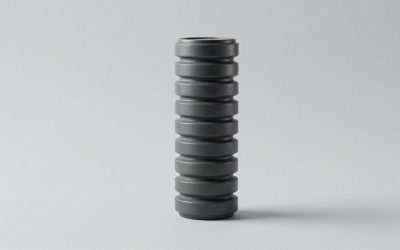
The best isolation feet for speakers are IsoAcoustics GAIA series for floor-standing speakers that need serious vibration control, SVS SoundPath Isolation System for subwoofers on flexible floors, and IsoAcoustics ISO-PUCK or Herbie’s Audio Lab Tenderfoot for bookshelf and studio monitors where floor protection and decoupling matter most. The right choice depends on your speaker weight, floor type, and whether you need height or tilt adjustment.
How Isolation Feet Actually Work
Isolation feet do two jobs: decouple the speaker cabinet from the surface it sits on, and manage internal resonance. Spikes couple the speaker to the floor for stability but transfer vibration. Isolation feet use compliant materials like sorbothane, elastomer, or patented isolators to absorb that energy and prevent it from exciting the floor, desk, or shelf, which in turn reduces mid-bass smear, floor boom, and rattling objects in the room.
Not all vibration control is equal. Soft sorbothane excels at absorbing low-frequency energy but can make a speaker feel wobbly if overloaded. Denser elastomers and vacuum-formed isolators provide more lateral stability, which matters for tall, narrow towers. The floor itself changes the result: on concrete slabs you will notice tighter imaging, on suspended wood floors you will notice a much bigger reduction in boom and transmission to neighbors.
What to Compare Before You Buy
1. Material and Decoupling Method
- Sorbothane / Viscoelastic polymer: Used in SVS SoundPath, Herbie’s Tenderfoot, and generic sorbothane hemispheres. Excellent broadband damping, especially below 200Hz. Very effective for subwoofers. Can leave rings on lacquered wood if left for years without a coin or disc underneath.
- Patented isolator with elastomer and vacuum suction: Used in IsoAcoustics GAIA and ISO-PUCK. Manages energy in both vertical and lateral planes. Keeps the speaker more stable while still decoupling. Less prone to compression set over time than cheap sorbothane.
- High-density foam and MDF platform: Used in Auralex SubDude and MoPAD. Decouples through mass and absorption rather than a foot alone. Best when the speaker sits on a resonant desk or hollow floor. Adds height and footprint.
- Rubber/cork composite: Budget option found in many universal feet. Better than hard rubber bumpers, but compresses faster and has lower weight accuracy.
2. Weight Rating Is Not Optional
Every isolation foot has a load window. Too light and it will not compress enough to isolate. Too heavy and it bottoms out and essentially becomes a hard foot that couples again. Always calculate per-foot load, not just total speaker weight.
Worked calculation: Take your speaker’s actual weight, including any stands or fill. Divide by the number of feet (usually 4). Then match that number to the per-foot rating. Example: A 52 lb bookshelf speaker on a 18 lb steel stand = 70 lbs total / 4 feet = 17.5 lbs per foot. An IsoAcoustics ISO-PUCK 76 (rated up to 40 lbs per puck) would be overkill and under-compressed. An ISO-PUCK Mini (rated 6 lbs per puck) would be overloaded. The standard ISO-PUCK (rated 20 lbs per puck) would be in the sweet spot. For a 95 lb tower, 95 / 4 = 23.75 lbs per foot, so IsoAcoustics GAIA II (rated 120 lbs per set of 4, or 30 lbs per foot) fits, while GAIA III (70 lbs per set) would be overloaded.
3. Height, Tilt, and Threading
Most isolation feet add 0.8 to 1.6 inches of height. Foam pads like Auralex MoPAD add up to 2 inches and include angled wedges for 4 to 8 degrees of tilt. Threaded feet like IsoAcoustics GAIA replace your existing spikes and can be height-adjusted to level speakers on uneven floors, but you need to match the thread size (commonly M6, M8, 1/4″-20). Universal elastomer feet like Herbie’s Tenderfoot and SVS SoundPath for subs are non-threaded and simply sit under the cabinet, so no thread matching is needed but you lose fine leveling.
4. Floor Protection
Hard plastic or metal feet can dent soft pine, vinyl plank, and LVP. Sorbothane and soft elastomer are generally floor-safe, while GAIA-style feet include a bottom suction cup that protects hard floors but can mark very soft wax finishes if not moved for a long time. If you have hardwood you care about, place a small stainless disc or felt pad under any foot that does not already have a soft base, and avoid brass spikes without cups.
Spec Comparison: Popular Isolation Feet in 2026
| Model | Material / Design | Capacity Per Set of 4 | Capacity Per Foot | Height Added | Threaded? | Best For |
|---|---|---|---|---|---|---|
| IsoAcoustics GAIA III | Patented isolator, elastomer | 70 lbs (32 kg) | 17.5 lbs | 1.1 in (28 mm) | Yes – M6, M8, 1/4″-20 adapters | Small to medium towers, heavy bookshelf on stands |
| IsoAcoustics GAIA II | Patented isolator, elastomer | 120 lbs (54 kg) | 30 lbs | 1.4 in (36 mm) | Yes | Mid-size towers 60-110 lbs |
| IsoAcoustics GAIA I | Patented isolator, elastomer | 220 lbs (100 kg) | 55 lbs | 1.5 in (38 mm) | Yes | Large towers, heavy subs |
| IsoAcoustics ISO-PUCK 76 | Isolator, elastomer | 160 lbs (4x 40 lbs) | 40 lbs | 1.4 in (36 mm) | No | Large monitors, center channels, small subs |
| IsoAcoustics ISO-PUCK (Standard) | Isolator, elastomer | 80 lbs (4x 20 lbs) | 20 lbs | 1.1 in (28 mm) | No | Bookshelf and studio monitors 10-20 lbs per foot |
| SVS SoundPath Isolation System | Sorbothane + elastomer + stainless | Varies by kit (4-6 feet) | ~10-15 lbs (sub-specific) | 1.0 in (25 mm) | Yes – fits most SVS, universal threads included | Sealed and ported subwoofers on wood floors |
| Herbie’s Audio Lab Tenderfoot | Sorbothane + compliant elastomer | ~60-80 lbs (4x 15-20 lbs) | 15-19 lbs (Standard) | 0.8 in (20 mm) | No | Turntables, tube gear, light to medium bookshelf speakers |
| Auralex MoPAD / SubDude-II | High-density foam + MDF | 100 lbs (MoPAD), 300 lbs (SubDude-II platform) | N/A – platform | 2.0 in (51 mm) MoPAD, 1.75 in SubDude | No | Desk monitors, subwoofers on hollow or boomy floors |
Prices in 2026 typically range from $25 to $60 for sets of generic sorbothane or rubber/cork feet, $55 to $110 for SVS SoundPath and Herbie’s Tenderfoot sets, $99 to $189 for ISO-PUCK packs of 4 to 8, and $199 to $599 for GAIA sets of 4 depending on size. Foam platforms like MoPAD and SubDude generally fall between $59 and $149.
Decision Matrix: Pick by Your Situation
| Your Situation | Recommended Type | Why |
|---|---|---|
| Floor-standing towers 40-70 lbs on hardwood or concrete | IsoAcoustics GAIA III | Correct load window, threaded leveling, strong floor protection and tighter stereo imaging |
| Floor-standing towers 70-120 lbs on suspended wood floor | IsoAcoustics GAIA II | Higher capacity prevents bottoming out, reduces floor excitation that causes boom in adjacent rooms |
| Bookshelf speakers on stands or shelf, under 25 lbs per speaker | IsoAcoustics ISO-PUCK Mini/Standard or Herbie’s Tenderfoot | Non-threaded, low profile, ideal decoupling without adding wobble |
| Studio monitors on a desk | Auralex MoPAD or ISO-PUCK | MoPAD adds tilt to aim tweeter to ear; ISO-PUCK decouples from desk without raising too high |
| Subwoofer causing neighbor complaints or rattling dishes | SVS SoundPath or SubDude-II platform + proper isolation feet | Sorbothane-based system designed for low-frequency isolation; platform spreads load on flexible floors |
| Tight budget, light speakers, rental apartment | Universal sorbothane hemispheres 40-50 durometer | Cheap and effective if you match durometer to weight; use a disc underneath to protect finish |
| Vintage hardwood you must not mark | Soft sorbothane or Tenderfoot with stainless coasters | Maximum floor protection; avoid hard spikes and bare metal |
Vibration Control for Different Speaker Sizes
Small Bookshelf and Desktop (4-15 lbs per speaker)
These are most affected by desk and shelf resonance. Four small feet rated 5 to 10 lbs per foot work better than one large high-capacity set. Keep the speaker stable; if you can rock it easily by pushing the top corner, the feet are too soft or overloaded.
Medium Bookshelf on Stands (15-40 lbs per speaker)
Isolate at both ends if possible: feet between speaker and stand plate, and feet or GAIA-style isolators between stand and floor. This is where threaded GAIA III or ISO-PUCK Standard show the clearest improvement in mid-bass clarity.
Tower Speakers (40-120+ lbs per speaker)
Weight rating is critical. Towers have high leverage, so lateral stability matters as much as vertical isolation. Patented isolators that control side-to-side movement outperform plain sorbothane hemispheres here. Always use the thread adapters and level the speaker after install.
Subwoofers (30-150 lbs)
Subs generate the most floor-transmitted energy. A 6-foot pattern often isolates better than 4, especially for large ported subs over 80 lbs. On wood floors over a crawlspace or second story, a platform like SubDude-II plus compliant feet reduces transmission more than feet alone.
Setup and Leveling: Get the Benefit Without the Wobble
- Weigh your speaker once. Use a bathroom scale for towers (weigh yourself with and without the speaker) or a kitchen scale for bookshelves. Include stand weight if the feet go under the stand.
- Clean the contact points with isopropyl alcohol. Oils reduce suction and cause slumping with sorbothane.
- For threaded feet, remove existing spikes completely, hand-thread the new isolator, then use the included wrench to adjust height until the speaker is level. Check with a small bubble level front-to-back and side-to-side.
- For non-threaded feet, place them directly under the cabinet corners, not under the existing rubber bumpers. If the bottom is vinyl-wrapped, center the load to avoid peeling the wrap.
- Recheck after 48 hours. Viscoelastic materials settle. Re-level and ensure no foot is visibly more compressed than the others.
Durability and Ownership Realities
What wears first is compression set. Cheap sorbothane hemispheres rated for 10 lbs but loaded with 18 lbs will flatten permanently within 6 to 12 months, especially in warm rooms. Higher-quality elastomers hold shape for 3 to 5 years before softening. Foam platforms absorb dust and pet hair and compress along the edges if dragged; vacuum them and lift rather than slide.
Cleaning: Wipe elastomer and sorbothane with water and mild soap only. Solvents and oils break down the polymer. Avoid placing sorbothane directly on oil-based polyurethane or fresh lacquer for long periods; the plasticizer can interact and leave a permanent ring. Use a metal disc or the supplied base.
Common mistakes: Mixing feet of different durometers or heights on the same speaker, overloading one side of a subwoofer with an amp plate, using spike cups with isolation feet (which re-couples them), and ignoring thread size so the foot cross-threads and tilts. Also, do not stack two isolation systems (e.g., soft feet on top of a soft foam pad) without testing stability, as the stack can become too compliant and introduce audible sway on tall towers.
FAQ
Do isolation feet improve sound quality or just reduce vibration?
Both, but the effect is floor-dependent. On concrete you may hear slightly cleaner bass and improved imaging. On suspended wood floors the difference is often much larger, with less boomy bass and less energy transfer to walls and furniture.
Are isolation feet better than spikes?
For most modern homes with wood, LVP, or upper floors, isolation feet are more useful than spikes. Spikes are preferred only when you want to couple a speaker firmly to a massive, inert slab and you are not concerned about floor marking or transmission.
How many feet should I use per speaker?
Four for most rectangular speakers. Three can work for small monitors if the feet are centered under the cabinet mass, but four spreads load more evenly and resists rocking. For large, heavy subwoofers, six feet often provide better weight distribution.