Key takeaways
- Check the mesh, not just the frame. Chicken wire helps contain hens but is not a dependable barrier against many predators. For exposed sides, use sturdy welded wire with openings small enough to resist local threats; a common choice is ½-inch hardware cloth. Secure it with screws and washers or other strong fixings, not a few staples.
- Protect the perimeter. A buried mesh skirt or outward-facing apron around the run helps deter digging animals. Covering the run overhead can also reduce risk from climbing or flying predators. Adapt the design to the animals in your area.
- Look for high, adjustable ventilation. Air should move through the coop without creating a cold draft across the roost. Vents near the roof help moisture escape; openings that can be partly closed are useful in severe weather, as long as airflow is not blocked completely.
- Test every latch. A door that merely swings shut may be easy for a predator to open. Use latches that stay secured against pulling or lifting, and check them after assembly.
- Make cleaning physically easy. A removable tray is useful only if it slides out fully and can be cleaned without lifting the coop. Large doors, a smooth floor, and access to corners matter more over time than decorative trim. Keep bedding dry and replace it as needed.
The best chicken coops for backyards are sized around the space your hens actually use—not the advertised bird count—and have a secure run, ample ventilation, and access that makes daily care practical. For a small flock in a compact yard, choose a coop with room to expand its run; for four to six hens, prioritize generous floor area and walk-in access over a tall, narrow design.
Compare space before you compare features
Coop makers’ capacity claims often assume hens spend much of the day outdoors. A more useful starting point is about 4 square feet of indoor floor space per standard-size hen and 8–10 square feet per hen in an attached run. These are planning guidelines, not guarantees: larger breeds, frequent confinement, harsh weather, or a flock that does not get free-range time call for more room.
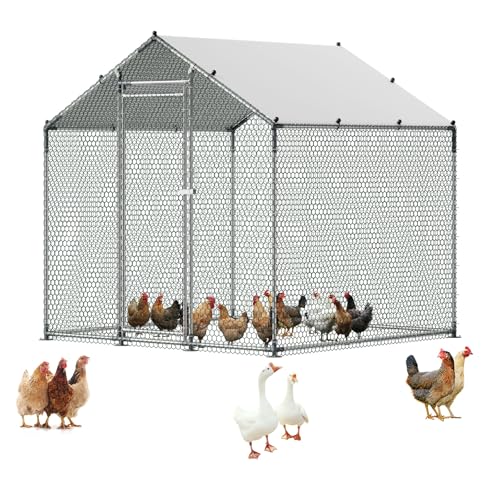
VEVOR Metal Chicken Coop, 6.56x6.56x6.56ft Large Walk-in Chicken Run with Cover, Spire Roof Hen House Enclosure with Security Lock, Outdoor Duck Rabbit Cage, Poultry Pen for Backyard, Farm, Yard
Included for 'Best Chicken Coops for Backyards: Space, Security, and Setup Compared' because the listing specifies 6.56x6.56x6.56ft Large Walk-in Chicken Run with Cover and Spire Roof Hen House Enclosure with Security Lock, details this guide uses to compare options.
View on Amazon
PetsCosset Chicken Coop with Wheels, Weatherproof Large Hen House Mobile Chicken Tractor with Nesting Box, Roosting Bars, Pull-Out Tray, Fun Swing for 4-6 Chickens Quails, Backyard Farm Use
Included for 'Best Chicken Coops for Backyards: Space, Security, and Setup Compared' because the listing specifies Roosting Bars and Pull-Out Tray, details this guide uses to compare options.
View on Amazon
Omitree Deluxe Large Wood Chicken Coop Backyard Hen House 6-10 Chickens with 6 Nesting Box
Included for 'Best Chicken Coops for Backyards: Space, Security, and Setup Compared' as a relevant option in this category; details come from the product listing.
View on Amazon
Outvita Chicken Coop, 19.5×10 FT Large Metal Chicken House, Poultry Habitat Cage with Waterproof Cover, Walk-in Chicken Run Pen for Small Animals, Yard, Farm, Patio
Included for 'Best Chicken Coops for Backyards: Space, Security, and Setup Compared' because the listing specifies 19.5×10 FT Large Metal Chicken House and Poultry Habitat Cage with Waterproof Cover, details this guide uses to compare options.
View on AmazonThe estimates below use clear floor area, excluding nest boxes and other fixtures that hens cannot comfortably stand or move around beneath. Check the manufacturer’s internal measurements where available; exterior dimensions can overstate usable space.
| Flock size | Suggested indoor floor area | Suggested run area | Example footprint to plan around |
|---|---|---|---|
| 2–3 hens | 8–12 sq. ft. | 16–30 sq. ft. | 4 × 3 ft. coop; 4 × 6 ft. run for three hens |
| 4 hens | 16 sq. ft. | 32–40 sq. ft. | 4 × 4 ft. coop; 4 × 8–10 ft. run |
| 6 hens | 24 sq. ft. | 48–60 sq. ft. | 4 × 6 ft. coop; 6 × 8–10 ft. run |
Those footprints are examples, not product specifications. A 4 × 8-foot run provides 32 square feet; that meets the lower planning target for four hens, but leaves little margin if they will be confined regularly. A small elevated coop paired with a short run can look spacious in a listing while still falling short once nest boxes and ramps occupy the usable area.
Choose by yard, flock, and routine
| Your situation | Best fit | What to prioritize |
|---|---|---|
| Two or three hens; very limited yard | Compact coop with a separately extendable run | Accurate interior dimensions, secure door latches, and room to add run panels |
| Four to six hens; daily access to a larger yard | Medium coop with a substantial attached run | Usable indoor floor space, shaded run area, and easy-to-reach cleaning doors |
| Four or more hens; frequent confinement | Walk-in coop and roomy walk-in run | More run area than the minimum, weather cover, and human-height access |
| Predators are a known concern | Rigid-frame coop and run that can be reinforced | Small-aperture welded wire, buried or outward-facing apron, and locking latches |
| First-time keeper or limited mobility | Simple, accessible design | Few awkward corners, removable trays, clear assembly instructions, and a reachable pop door |
Coop styles worth considering
Compact wooden coop with an attached run
This style suits a small flock and a small yard, particularly when hens will spend part of the day outside the run. Look for a solid frame, roof over at least part of the run, and a cleaning door large enough to reach the far corners. Thin timber and small runs are common compromises in budget models. If the run cannot be expanded and your birds will be confined often, choose a larger design instead.
Walk-in coop and run
A walk-in setup is the practical choice for a larger flock or for keepers who need regular access in bad weather. Being able to step inside makes bedding changes, inspections, and retrieval of a hiding hen easier. It also takes up more yard space and requires a level, well-drained base. Confirm that the door openings and interior layout—not just the roof height—allow you to clean comfortably.
Recycled-plastic or metal-panel coop
Non-wood materials can reduce concerns about rot or pests in the coop structure, but material alone does not make a secure enclosure. Inspect seams, corners, fasteners, and the connection between coop and run. Metal can heat up in direct sun, while plastic panels still need adequate ventilation and a stable frame. Provide shade and airflow appropriate to your climate.
Security, ventilation, and cleaning: the details that matter
- Check the mesh, not just the frame. Chicken wire helps contain hens but is not a dependable barrier against many predators. For exposed sides, use sturdy welded wire with openings small enough to resist local threats; a common choice is ½-inch hardware cloth. Secure it with screws and washers or other strong fixings, not a few staples.
- Protect the perimeter. A buried mesh skirt or outward-facing apron around the run helps deter digging animals. Covering the run overhead can also reduce risk from climbing or flying predators. Adapt the design to the animals in your area.
- Look for high, adjustable ventilation. Air should move through the coop without creating a cold draft across the roost. Vents near the roof help moisture escape; openings that can be partly closed are useful in severe weather, as long as airflow is not blocked completely.
- Test every latch. A door that merely swings shut may be easy for a predator to open. Use latches that stay secured against pulling or lifting, and check them after assembly.
- Make cleaning physically easy. A removable tray is useful only if it slides out fully and can be cleaned without lifting the coop. Large doors, a smooth floor, and access to corners matter more over time than decorative trim. Keep bedding dry and replace it as needed.
Assembly and ownership costs
Before ordering, compare the parts list with what the listing actually includes. Some coop packages include the run but not a rain cover, ground anchors, or the hardware needed to reinforce vulnerable mesh. Budget models commonly fall in the low hundreds of dollars; larger walk-in systems and more robust construction can cost several hundred dollars or more. Set aside extra for predator-resistant wire, fasteners, anchors, and weather protection if those are not included.
Plan to assemble the coop on level ground with enough clearance to open doors and remove trays. Have a second person help with larger panels, and check the frame for square before tightening every fastener; a twisted frame can leave door gaps or make latches misalign. After assembly, inspect the bottom edges, corners, roof joints, and mesh attachments. Fix gaps before adding birds.
Wooden coops need periodic checks for soft spots, loose joints, and peeling finishes. Roof coverings and exposed fasteners can wear before the main frame. Mesh can loosen where it is attached, and sliding trays may corrode or become difficult to clean if waste collects around their edges. A quick routine inspection, particularly after storms and before nighttime lock-up, can catch problems before they become a breach.
Make the final choice by the space you can maintain
For a few hens and occasional daytime roaming, a compact coop can work if its indoor area is adequate and its run can be extended. For four to six birds, favor a design with enough real floor space, a run that meets your confinement needs, and doors that make daily care manageable. Where predators are a concern, treat the included enclosure as a starting point unless its mesh, seams, perimeter, and latches are clearly robust. The best choice is the one that fits your flock today while leaving you enough room—and access—to keep it clean and secure.