Key takeaways
- Power: 1,500 watts, standard 120-volt household circuit
- Heat delivery: fast-heat element, roughly 3-second element warm-up per listing
- Safety: overheat protection with automatic shutoff
- Form factor: portable outdoor/patio-adjacent garage heater
- Placement: floor or low surface, directional
- Price tier: budget
Best Space Heaters for Large Garages: The Direct Answer
The best space heater for a large garage is generally the Comfort Zone Hard-Wired Ceiling Mount Garage Space Heater if you have a 240-volt circuit available, because a 7,500-watt fan-forced ceiling unit is the only category of heater on this list that can genuinely raise the temperature of a 600–900 sq ft space rather than just warm the people standing near it. If you are limited to a standard 120-volt outlet, your realistic ceiling is about 5,100 BTU per 1,500-watt heater, and the wiser strategy is to pick a directional radiant or infrared unit that heats objects and bodies instead of trying to heat all the air in an uninsulated box. For a shop where you mostly need comfort at one bench, the DREO 30″ Large Room Tower and the Landeagle 37″ Infrared Radiant are the two strongest picks depending on whether you want air movement or instant radiant warmth. For a tight budget, the Buyplus 1500W Portable Garage Heater delivers the core features at the lowest cost tier.
Top 3 Picks
Best Overall: Comfort Zone Hard-Wired Ceiling Mount Garage Heater
A 7,500-watt, 240-volt fan-forced ceiling unit is the closest thing to a real garage heating system that still counts as a space heater. It mounts overhead, keeps the floor clear, and delivers roughly 25,600 BTU — enough output to matter in a two-car garage. The trade-off is that it needs a dedicated 240-volt circuit and professional wiring, so it is not a plug-and-forget purchase.
Best Budget: Buyplus 1500W Portable Garage Heater
At the budget tier, the Buyplus covers the essentials: 1,500 watts, overheat protection, and a fast-heat element that the listing claims reaches temperature in about three seconds. It is a portable, directional heater, so treat it as spot heating for a workbench rather than whole-garage climate control.
Best Premium for Spot Comfort: Landeagle 37″ Outdoor Infrared Patio Heater
The Landeagle is the premium pick for anyone who wants warmth on demand and does not want to run new wiring. A 37-inch, 1,500-watt infrared radiant heater with an IP rating warms surfaces and people directly, which suits an open garage door, a car-washing bay, or a patio-adjacent workspace better than a convection unit. It is also the most weather-tolerant design in this roundup.
Quick Comparison
| Product | Best For | Key Specs | Price Tier |
|---|---|---|---|
| Buyplus 1500W Portable Garage Heater | Budget spot heating at a bench | 1,500W, overheat protection, ~3s fast heat, portable, 120V | Budget |
| DREO 1500W Indoor Space Heater with Thermostat | Small garages needing a familiar thermostat | 1,500W, digital thermostat, 120V, compact footprint | Mid-range |
| MEPTY Electric Mica Infrared Heater | Quiet, even radiant heat in a working space | Mica infrared element, digital thermostat, energy-saving modes, 120V class | Premium |
| DREO 25″ Electric Space Heater for Large Room | Tall tower heating with thermostat control | 25-inch tower, thermostat, large-room airflow, 120V class | Mid-range |
| Lasko 23″ Ceramic Tower Heater with Remote | Remote-controlled tower heat on a budget | 23-inch ceramic tower, remote, oscillation, 1,500W class | Budget |
| DREO 1500W Portable Tilt Heater | Desk and office-adjacent garage tasks | 1,500W, 60° adjustable tilt, portable, 120V | Budget |
| BEYOND HEAT 1500W Radiant Garage Heater (2-Pack) | Two-zone garage coverage | 1,500W each, 120V, radiant, 2 units included | Mid-range |
| DR. INFRARED HEATER Portable Infrared Heater | Indoor/outdoor mixed-use radiant warmth | Infrared, portable, indoor/outdoor and commercial rated, 120V class | Mid-range |
| DAHTEC 1500W Portable Ceramic Heater | Cheap, small, moveable warmth | 1,500W, ceramic element, portable, 120V | Budget |
| DREO 30″ Large Room Tower with Remote | Whole-garage air circulation on 120V | 30-inch tower, 120° oscillation, remote, 1,500W class | Premium |
| Comfort Zone Hard-Wired Ceiling Mount Heater | True large-garage heating | 7,500W, 240V, fan-forced, remote, overheat protection, ceiling mount | Premium |
| Landeagle 37″ Outdoor Infrared Patio Heater | Instant radiant heat in open or drafty bays | 37-inch, 1,500W, infrared radiant, IP-rated, portable | Premium |
3 Basis of Selection
Every product here was assessed on specifications published by the manufacturer or plainly stated in the product listing name, plus well-established facts about how each heater class works — not on physical trials. Three filters drove the list. First, category fit: does the unit plausibly belong in a garage rather than a bedroom or an office? That favors ruggedized, radiant, and ceiling-mount designs over decorative towers, though towers remain useful for finished and insulated shops. Second, voltage and circuit reality: a 120-volt heater tops out around 1,500 watts, and any honest recommendation has to acknowledge that ceiling. Third, control and safety: a usable thermostat, an overheat cutoff, and a credible mounting or placement scheme. Upgrade path mattered too. We included budget portables for readers who need warmth now and wiring later, alongside 240-volt hard-wired options for readers willing to make a permanent investment. Where a listing was vague, the product is described by specification class rather than by a guessed number.
1. Buyplus 1500W Portable Garage Heater — Best for Budget Spot Heating

Buyplus Outdoor Heaters for Patio, 1500W Portable Garage Heater with Overheat Protection & 3S Fast Heating, Non-Slip Cushion, Electric Space Heater for Patio, Garage, Bedroom, Office, Black
Included for 'Best Space Heaters for Large Garages' because the listing specifies Non-Slip Cushion and Electric Space Heater for Patio, details this guide uses to compare options.
View on AmazonThe Buyplus is the entry point for anyone who needs heat in a garage this week and does not want to think about electricians, permits, or load calculations. It is a 1,500-watt portable heater with overheat protection and a fast-heating element that the listing describes as reaching temperature in roughly three seconds. That “three seconds” figure is about the element, not the room — it means the coil or element itself glows hot almost immediately, which is characteristic of radiant and forced-air designs. The air around your feet will still take time to feel different.
Key Specs
- Power: 1,500 watts, standard 120-volt household circuit
- Heat delivery: fast-heat element, roughly 3-second element warm-up per listing
- Safety: overheat protection with automatic shutoff
- Form factor: portable outdoor/patio-adjacent garage heater
- Placement: floor or low surface, directional
- Price tier: budget
Who It Suits
This is the heater for the reader who uses a garage as a workshop for two hours at a time, a few evenings a week, in a climate that gets cold but not brutally so. It suits renters who cannot modify wiring, homeowners who are not ready to commit to a 240-volt circuit, and anyone who wants a backup unit to supplement a bigger system on the coldest nights. It is a poor fit for someone trying to hold a 900 sq ft uninsulated garage at 65°F all winter; no 1,500-watt heater can do that.
Strengths
The chief strength is simplicity. Plug it in, point it where you are standing, and you get warmth without any installation cost. Overheat protection is the one safety feature that genuinely matters on a cheap portable, and it is present here. Because the unit is small and light, it stores on a shelf and moves between the garage, the patio, and a shed without complaint.
There is also a real cost argument. At typical U.S. residential rates, a 1,500-watt heater draws 1.5 kilowatt-hours per hour of run time. If your electricity costs about 16 cents per kilowatt-hour, that is roughly 24 cents per hour — a figure you can multiply by your actual usage to see whether a bigger heater is worth the wiring expense. Compare that to the Comfort Zone below, which burns 7.5 kWh per hour of run time and therefore costs roughly five times as much to operate, but also produces about five times the heat.
How It Compares
Against the DAHTEC 1500W ceramic portable, the Buyplus is positioned more explicitly toward garages and patios by its listing, while the DAHTEC is a general-purpose indoor ceramic. Functionally they occupy the same budget tier and the same 1,500-watt ceiling. Against the BEYOND HEAT two-pack, the Buyplus gives you one unit and one price; the two-pack gives you redundancy and two-zone coverage for roughly the cost of moving up a tier. If your garage has two distinct work areas, the pair is the smarter buy.
Pros
- Lowest price tier in this roundup
- Runs on any standard 120-volt outlet — no wiring project
- Overheat protection built in
- Portable and easy to store
- Suitable for patio and semi-outdoor use per its listing
Cons
- 1,500 watts cannot heat a large garage, only a zone around it
- No meaningful thermostat control described
- Fast-heat claims refer to the element, not the room
- No mounting hardware or overhead option
- Cord length and outlet proximity may dictate placement
2. DREO 1500W Indoor Space Heater with Thermostat — Best for Small Garages with Thermostat Control

DREO Space Heaters for Indoor Use with Thermostat, 1500W Electric Heaters
Included for 'Best Space Heaters for Large Garages' because the listing specifies 1500W Electric Heaters, details this guide uses to compare options.
View on AmazonDREO’s mainstream 1,500-watt heater with thermostat is the sensible middle of the market. It does not try to be a garage heater; it tries to be a good heater, and the thermostat is what makes it usable in a workshop. Instead of running flat out until you unplug it, a thermostat-equipped heater cycles on and off to hold a target temperature, which cuts both wasted electricity and the annoyance of a space that swings from cold to stifling. For a one-car garage or a well-insulated two-car garage, this is a realistic primary heater.
Key Specs
- Power: 1,500 watts, 120-volt
- Control: adjustable thermostat for set-point operation
- Intended use: indoor spaces, including garages, workshops, and basements
- Form factor: compact portable
- Safety: overheat protection typical of the category
- Price tier: mid-range
Who It Suits
The reader with a 200–400 sq ft garage who wants to set a temperature and forget it. Also the reader who works in the garage for long stretches — four, six, eight hours — where a heater without a thermostat becomes a nuisance. It is the right choice for a converted garage gym, a home office over a garage, or a workshop where consistent temperature matters more than peak blast heat. It is the wrong choice for an open, drafty, uninsulated three-car garage.
Strengths
The thermostat is the headline. In practice, a thermostat turns a 1,500-watt heater from an on/off appliance into a maintainable climate tool, and it changes the operating-cost math: a heater that runs 50% of the time costs half as much to run as one that runs constantly. That matters more than a few hundred watts of rated output, which is why thermostat control is one of our primary selection criteria.
The compact form factor also helps in a garage, where floor space is contested by cars, bikes, and tool chests. A small unit tucks under a bench or against a wall and does not become an obstacle.
How It Compares
Against the DREO 25-inch tower, this model is smaller and likely cheaper but moves less air. Towers win on circulation; compacts win on placement flexibility and price. Against the MEPTY mica infrared, the difference is heat type: the DREO moves heated air, the MEPTY radiates. Air movement warms a room faster but stirs dust and dries the air; radiant heat is quieter and gentler but warms surfaces rather than the whole volume. If your garage is dusty — and most are — a radiant unit like the MEPTY may need less cleaning attention.
Pros
- Thermostat control keeps temperature stable and trims run time
- 1,500 watts on a standard outlet with no installation
- Compact enough for cramped garage layouts
- DREO is an established name in the small-appliance heater category
- Sensible mid-range price tier
Cons
- Still limited to 1,500 watts and roughly 5,100 BTU
- Not designed specifically for harsh garage conditions
- Less air throw than a tall tower
- No overhead mounting option
- Not suitable for wet or semi-outdoor use
3. MEPTY Electric Mica Infrared Heater — Best for Quiet, Even Radiant Heat

MEPTY Space Heater Large Room,Electric Mica Infrared Heaters for Indoor Use,Digital Thermostat,Energy Saving,Overheat & Tip-Over Protection,360°Whole Room Heater for Indoor Use,Bedroom,Office,Garage
Included for 'Best Space Heaters for Large Garages' because the listing specifies Electric Mica Infrared Heaters for Indoor Use and Digital Thermostat, details this guide uses to compare options.
View on AmazonMica infrared heaters use a mineral-insulated heating element that glows behind a panel and radiates heat directly at people and objects. Unlike a fan-forced heater, there is no blower pushing air around, which makes the MEPTY notably quieter and less likely to stir up the sawdust and dust that live in every working garage. The listing pairs the mica infrared element with a digital thermostat and energy-saving modes, which together make it one of the more controllable radiant options here.
Key Specs
- Heat type: mica infrared radiant panel
- Control: digital thermostat
- Modes: energy-saving settings
- Intended use: indoor large-room heating
- Air movement: minimal — radiant rather than fan-forced
- Price tier: premium
Who It Suits
This is the pick for a reader who spends long hours in the garage and dislikes fan noise, or who has respiratory sensitivity to dust. It also suits a garage used as a hobby room, art studio, or home gym where a steady, unobtrusive background warmth is preferable to a blast of hot air. Because radiant heat warms surfaces, it is efficient for a person seated or standing within its line of sight, but it will not heat the far corner of a 900 sq ft bay.
Strengths
The digital thermostat plus energy-saving modes is a strong combination. Radiant heaters without thermostats tempt you to leave them on and forget them; with a thermostat, the unit self-regulates. Radiant heat also has a practical advantage in a garage with high ceilings: because it does not rely on heating air that will rise and stratify near the roof, more of the energy reaches the occupied zone at floor and bench level.
Quiet operation is a durability advantage as well. Fans are one of the first things to fail in any heater — bearings wear, blades collect dust, and motors die. A heater with no blower has one fewer consumable part.
How It Compares
Against the DR. INFRARED HEATER, both are radiant, but the MEPTY is positioned as a large-room indoor unit with digital thermostat control, while the DR. INFRARED is pitched at portable indoor/outdoor and commercial use. If your garage has an open door or you work in a carport, the DR. INFRARED’s outdoor rating is the deciding factor. If your garage is closed and you want the most precise temperature control, the MEPTY has the edge. Against the DREO 25-inch tower, choose MEPTY for quiet radiant comfort and DREO for faster air warming.
Pros
- Radiant heat does not rely on heating ceiling-height air
- Digital thermostat with energy-saving modes
- Quiet — no blower noise
- No fan to wear out or clog with dust
- Good fit for long-duration occupancy
Cons
- Premium price tier
- Radiant heat is directional; it will not warm a whole large bay
- No air circulation, so cold spots persist in corners
- Not rated for wet or outdoor use
- Slower to change the temperature of a room compared with forced air
4. DREO 25″ Electric Space Heater for Large Room — Best for Tall-Tower Air Circulation

DREO 25 Inch Electric Space Heater for Indoor Use, Large Room, Thermostat
Included for 'Best Space Heaters for Large Garages' because the listing specifies Large Room and Thermostat, details this guide uses to compare options.
View on AmazonA 25-inch tower heater is the compromise between a compact portable and a full-size tower. DREO’s 25-inch large-room model pairs a thermostat with a taller column and a larger air outlet, which means better throw than a tabletop unit without the footprint of a 30-inch tower. For a garage where you want the air itself warmed — not just the objects in the beam of a radiant panel — this is the more effective of the two approaches.
Key Specs
- Form factor: 25-inch tower
- Control: thermostat
- Intended use: large-room indoor heating
- Power: 1,500-watt class, 120-volt
- Air delivery: tower outlet with broader throw than compact units
- Price tier: mid-range
Who It Suits
The reader with a mid-size garage — call it 300–500 sq ft — who wants the air temperature to come up, not just the temperature of their hands. Tower heaters excel when the garage door stays closed and the space is at least moderately sealed. They suit a workshop with several stations, a garage gym, or a finished shop where you move around rather than sitting in one spot.
Strengths
Circulation is the point. A tower draws cool air in at the base, heats it, and pushes it out across the room, which slowly homogenizes the temperature. That means a person standing eight feet away still benefits, unlike with a small directional unit. The thermostat keeps the cycle efficient, and the tall, narrow footprint takes up less floor area than a boxy heater of comparable output.
Tower designs also tend to place controls and displays at a comfortable height, so you are not crouching to read a display or reaching under a bench to find a knob.
How It Compares
The obvious comparison is the DREO 30-inch tower with 120° oscillation. The 30-inch model is the upgrade: taller, with oscillation, and bundled with a remote, which suits a larger garage where you do not want to walk to the heater to adjust it. The 25-inch model is the value play — same brand, same thermostat philosophy, less air throw and no oscillation. If your garage is under 400 sq ft, save the difference. Above that, the 30-inch earns its premium tier.
Against the Lasko 23-inch ceramic tower, both are towers in the same general size class, but the Lasko sits at the budget tier and includes a remote, making it a tempting alternative. The DREO’s advantage is its positioning around large rooms and thermostat-centric control.
Pros
- Better air throw than compact or tabletop heaters
- Thermostat control
- Slim footprint for its output
- Controls at a convenient height
- Mid-range pricing rather than premium
Cons
- No oscillation, unlike the larger DREO tower
- Still capped at 1,500 watts and roughly 5,100 BTU
- Towers can be tipped by pets or by garage clutter — keep the tip-over switch in mind
- Not for wet or outdoor use
- Less effective in a drafty garage with an open door
5. Lasko 23″ Ceramic Tower Heater with Remote — Best Budget Tower with Remote

Lasko 23" Ceramic Tower Space Heater with Remote Control - Silver - 751320
Included for 'Best Space Heaters for Large Garages' because the listing specifies Silver and 751320, details this guide uses to compare options.
View on AmazonLasko has been building portable heaters for decades, and the 23-inch ceramic tower with remote is one of the category’s familiar shapes. Ceramic element towers heat up quickly, and the included remote is the feature that separates this from most budget heaters — you can adjust it from across the garage without crossing a cold floor. Available in a silver finish, it is one of the more conventional-looking options in a roundup that leans toward utilitarian.
Key Specs
- Form factor: 23-inch ceramic tower
- Power: 1,500-watt class, 120-volt
- Control: remote control, with onboard controls
- Element: ceramic
- Finish: silver
- Price tier: budget
Who It Suits
Budget-conscious readers who want tower-style airflow and remote convenience without paying premium-tier prices. It suits a small-to-mid garage, a workshop corner, or a garage that doubles as a laundry or utility room. It is also a reasonable choice for a reader who wants a heater that looks at home indoors if it later migrates from the garage into the house.
Strengths
Remote control is genuinely useful in a garage, where the heater often ends up against a wall behind a vehicle. Being able to power it on and raise the set point from the doorway is the kind of small convenience that determines whether a heater actually gets used. Ceramic elements also reach operating temperature quickly, so the wait for warmth is short relative to the size of the unit.
Lasko’s long presence in this category means replacement parts and service expectations are at least familiar; this is a mature product type rather than a novelty.
How It Compares
Against the DREO 25-inch tower, the Lasko is cheaper and includes a remote the DREO 25-inch model does not advertise. The DREO counters with a thermostat-forward design and large-room positioning. If remote control and price are your priorities, the Lasko wins. If precise set-point control and slightly better throw matter more, the DREO does. Against the DREO 30-inch tower, the Lasko is a clear step down in size and output but also in price tier.
Pros
- Remote control at a budget price tier
- Ceramic element heats quickly
- Established brand in the portable heater category
- Tower airflow in a slim, house-friendly shape
- Familiar, widely available product type
Cons
- Budget-tier build and output ceiling
- 1,500 watts limits it to a small or well-insulated garage
- Less air throw than larger 30-inch towers
- Not intended for garages that are wet or open to the outdoors
- Remote requires line of sight and stored batteries
6. DREO 1500W Portable Tilt Heater — Best for Bench and Desk-Side Use

DREO Space Heater 1500W, 60° Adjustable Tilt, Portable Heater for Office
Included for 'Best Space Heaters for Large Garages' because the listing specifies 60° Adjustable Tilt and Portable Heater for Office, details this guide uses to compare options.
View on AmazonThis is the small, aimed heater: 1,500 watts, a 60-degree adjustable tilt, and a body light enough to move with one hand. The listing places it in office use, and that is a fair description of its personality — it is a personal heater that happens to be powerful enough to be useful in a garage. The tilt function is what makes it interesting, because you can angle the output at your hands, your feet, or the underside of a car you are working on.
Key Specs
- Power: 1,500 watts, 120-volt
- Adjustability: 60° tilt range
- Form factor: compact portable
- Intended use: office, desk, and personal spot heating
- Safety: overheat protection typical of the class
- Price tier: budget
Who It Suits
The reader who spends most of their garage time in one place — at a bench, under a hood, at a reloading table, or at a desk in a converted corner. It is also the right unit for a reader who wants heat at the moment they start working, without waiting for a room to come up to temperature. It is a poor choice for anyone who expects to walk into a warm garage twenty minutes after switching it on.
Strengths
Aimability is the whole value proposition. Radiant and directional heaters are most efficient when the beam lands on a person, and a 60-degree tilt lets you tune that. Combined with a budget price tier and a small footprint, it is the least expensive way to get targeted warmth where you actually stand.
It is also the easiest heater here to justify as a second unit. Pair it with a larger tower or a ceiling-mount system and use it for the last few degrees of comfort at a specific station.
How It Compares
Against the DAHTEC 1500W ceramic portable, the two are direct competitors at the budget tier with the same power draw. The differentiator is the tilt: if you want to aim heat, this is the more flexible unit; if you want a simple ceramic box to set on the floor, the DAHTEC is the plainer option. Against the Buyplus, the Buyplus lists overheat protection and a fast-heat element explicitly and positions itself for garage and patio use, whereas this DREO is framed as an office personal heater. In a garage, the Buyplus’s stated positioning is the better match on paper.
Pros
- 60° tilt lets you aim heat precisely
- Compact and easy to reposition
- Budget price tier
- Fast warmth for a person rather than a room
- Useful as a supplemental second heater
Cons
- Personal heater — will not warm a large garage
- No thermostat or room-temperature control described
- Not built for outdoor or wet conditions
- Small body can be knocked over in a cluttered garage
- Positioning-sensitive: warmth drops off quickly outside the beam
7. BEYOND HEAT 1500W Radiant Garage Heater (2-Pack) — Best for Two-Zone Garage Coverage

BEYOND HEAT Electric Garage Heater 120V, 1500W Radiant Space Heater, 2-Pack
Included for 'Best Space Heaters for Large Garages' because the listing specifies 1500W Radiant Space Heater and 2-Pack, details this guide uses to compare options.
View on AmazonThe two-pack is an unusual and sensible idea for garages, which are often long and narrow with two distinct working ends. Two 1,500-watt radiant heaters at opposite ends of a bay can cover more usable area than one 3,000-watt unit would, because you can position each one where a person actually stands. Both are 120-volt, so the wiring requirement is just two separate outlets on circuits that can handle 1,500 watts each.
Key Specs
- Quantity: two heaters included
- Power: 1,500 watts each, 120-volt
- Heat type: radiant
- Intended use: garage spot heating
- Installation: plug-in, no hardwiring
- Price tier: mid-range
Who It Suits
Readers with a long garage, a tandem garage, or two separate work zones — say, a woodworking bench at one end and a mechanic’s area at the other. It also suits a household with two drivers who each want warmth near their own bay. And it is a good fit for a reader who wants redundancy: if one unit fails or is lent to the patio, the garage still has heat.
Strengths
Distributed heat beats concentrated heat in an elongated space. Radiant panels warm what they face, so two panels facing two work areas is a more practical arrangement than one panel trying to cover both. You also avoid the circuit problem that a single high-wattage 240-volt unit creates, because each heater is a normal 120-volt load.
Practical redundancy is the underrated benefit. Garage heaters fail, cords get damaged, and elements burn out; having a second identical unit on hand means a bad night does not end your project.
How It Compares
Against the Buyplus single portable, you are trading one unit’s lower price for two units’ coverage and backup — for a long garage, the pair is the better value. Against the DR. INFRARED portable, the difference is environment: the DR. INFRARED is rated for indoor and outdoor commercial and residential use, so it handles a carport or an open bay; the BEYOND HEAT pair is a garage-focused indoor radiant solution. If your garage door stays open while you work, look at the DR. INFRARED or the Landeagle instead.
Pros
- Two heat sources for long or two-zone garages
- Radiant heat warms people and objects directly
- Both units use standard 120-volt outlets
- Redundancy if one unit fails
- Mid-range tier for two heaters is strong value
Cons
- Two heaters means two outlets on adequate circuits
- Radiant output is directional and drops off with distance
- Combined output still equals only about 10,200 BTU total
- No thermostat control described
- Indoor garage use rather than weather-rated outdoor use
8. DR. INFRARED HEATER Portable Infrared Heater — Best for Indoor/Outdoor and Commercial Use
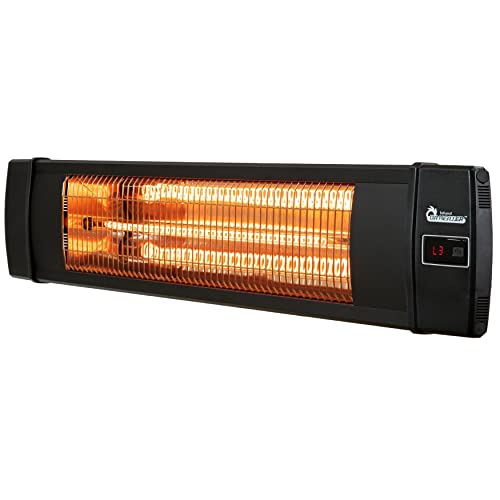
DR. INFRARED HEATER Portable Infrared Indoor and Outdoor Space Heater for Patio, Garage, Commercial & Residential With Remote Control, Without Thermostat, Black
Included for 'Best Space Heaters for Large Garages' because the listing specifies Garage and Commercial & Residential With Remote Control, details this guide uses to compare options.
View on AmazonThe DR. INFRARED portable is the flexible specialist in this list. Its listing covers indoor and outdoor use across patio, garage, commercial, and residential settings, which is a broader brief than any other heater here. Infrared radiant heat is the right technology for that breadth, because it does not depend on trapping warmed air inside a sealed room — it heats what it is pointed at, even in moving air.
Key Specs
- Heat type: infrared radiant
- Portability: portable with a handle-oriented form factor
- Rated environments: indoor and outdoor, commercial and residential
- Power: 120-volt class
- Use cases: patio, garage, workshop, job site
- Price tier: mid-range
Who It Suits
Anyone whose “garage” is part workshop and part outdoor room. If you detail cars with the door up, run a home business out of a barn, host people in a carport, or work on a covered porch attached to the garage, an indoor/outdoor-rated radiant heater is the only sane category to buy. It also suits contractors who need warmth that travels between sites.
Strengths
The indoor/outdoor rating is the differentiator. Every convection tower in this roundup assumes still air and a sealed room. Radiant heat works in a breeze, which makes it the correct choice for a bay with the door open or a workspace that is effectively semi-outdoor. Infrared also delivers warmth within seconds of being aimed, which is preferable to waiting on a room to heat up when you are only outside for twenty minutes.
Portability plus a commercial-use rating means it can do double duty as a patio heater in the shoulder seasons, spreading the cost across more of the year.
How It Compares
Against the MEPTY mica infrared, both are radiant, but the MEPTY offers a digital thermostat and energy-saving modes for precise indoor control, while the DR. INFRARED offers environmental flexibility. If your garage is closed and you want set-and-forget temperature management, MEPTY is the better match. If your space is open or you need one heater for garage and patio alike, this is the one. Against the Landeagle 37-inch infrared, the Landeagle is the larger, IP-rated premium option with a 37-inch radiant footprint — more coverage at a higher tier, and the better pick if the heater will live outdoors.
Pros
- Rated for indoor and outdoor use, including commercial settings
- Infrared heat works in drafty or open spaces
- Fast, directional warmth
- Portable between garage, patio, and job sites
- Mid-range price tier
Cons
- No thermostat control described; manual management likely
- Heats objects and people, not the whole room
- Output still limited by a standard 120-volt circuit
- Radiant beam requires positioning discipline
- Not a substitute for real garage heating in severe cold
9. DAHTEC 1500W Portable Ceramic Heater — Best for Cheap, Simple, Moveable Warmth

DAHTEC 1500W Electric Space Heater for Indoor Use, Portable Ceramic Heater
Included for 'Best Space Heaters for Large Garages' because the listing specifies Portable Ceramic Heater, details this guide uses to compare options.
View on AmazonThe DAHTEC is the plain-Jane option: 1,500 watts, a ceramic element, and a portable body. There is nothing exotic here, and that is the appeal. Ceramic heaters are simple, reliable, and cheap to make, which is why they dominate the budget tier. This one is for the reader who wants warmth at the lowest possible cost and does not need thermostats, remotes, oscillation, or mounting hardware.
Key Specs
- Power: 1,500 watts, 120-volt
- Element: ceramic
- Form factor: compact portable
- Intended use: indoor personal and small-space heating
- Safety: overheat protection typical of the class
- Price tier: budget
Who It Suits
A reader with a one-car garage doing occasional work, or a reader who wants a spare heater to keep in a cabinet for cold snaps. It is also a sensible choice for a laundry room, mudroom, or utility space attached to a garage, where a small ceramic heater is exactly the right size.
Strengths
The strength is cost and simplicity. Fewer features mean fewer things to break, and ceramic elements are robust. There is no remote to lose battery contact, no oscillation gear to strip, and no digital board to fail. For occasional use, that simplicity is a real durability advantage — the most reliable heater is the one with the fewest moving parts.
How It Compares
Against the DREO 1500W tilt heater, the DAHTEC gives up the 60-degree tilt in exchange for a conventional, uncomplicated shape, and both sit at the budget tier. Against the Buyplus, the DAHTEC lacks the garage/patio positioning and the explicitly listed fast-heat claim, so for a garage application the Buyplus is the more purpose-aligned pick. Against the Lasko tower, the DAHTEC is smaller and cheaper but has no remote and no tower airflow.
Pros
- Low budget price tier
- Ceramic element is simple and durable
- Portable and compact
- No complex electronics to fail
- Adequate for small or occasional-use spaces
Cons
- No thermostat, remote, or oscillation described
- Output limited to a small area
- Not designed for wet or outdoor conditions
- 1,500-watt ceiling applies as with all 120-volt units here
- No mounting option for overhead placement
10. DREO 30″ Large Room Tower with Remote — Best for Whole-Garage Air on 120 Volts

DREO Space Heater Large Room, 120° Oscillation, 30" Heaters with Remote
Included for 'Best Space Heaters for Large Garages' because the listing specifies 120° Oscillation and 30" Heaters with Remote, details this guide uses to compare options.
View on AmazonIf you cannot or will not install a 240-volt circuit but still want the most room-heating performance a standard outlet can deliver, the 30-inch DREO tower is the strongest candidate in this roundup. It is the largest tower here, with 120-degree oscillation and a remote, and it is positioned explicitly for large rooms. Oscillation matters more than it sounds: a stationary tower creates a hot column and a cold corner, while a sweeping tower distributes heat across a wider arc.
Key Specs
- Form factor: 30-inch tower
- Oscillation: 120° sweep
- Control: remote control with onboard controls
- Intended use: large-room indoor heating
- Power: 1,500-watt class, 120-volt
- Price tier: premium
Who It Suits
The reader with a 400–600 sq ft garage, decent insulation, and no appetite for electrical work. It also suits someone who wants to control the heater from inside the house or from the driver’s seat of a car being warmed in the bay. For a garage gym or a shop where people move around across a wide area, oscillation meaningfully improves perceived comfort.
Strengths
Distribution is the advantage. Combined with a thermostat, oscillation turns a point source into a broad, gently moving warmth that raises the average air temperature of a room rather than creating one hot spot. The remote removes the need to walk to the unit, which matters in a garage where the heater sits behind a vehicle.
For a reader who wants the maximum from a 120-volt circuit without rewiring, this is the most capable tower design in the list.
How It Compares
Against the DREO 25-inch tower, this is the direct upgrade: bigger, oscillating, remote-controlled, and one tier higher in price. If your garage is over 400 sq ft, the extra sweep is worth it; under that, the 25-inch is the smarter spend. Against the Comfort Zone ceiling unit, the comparison is category-level: the DREO heats air and moves it around at 1,500 watts, while the Comfort Zone produces 7,500 watts of fan-forced heat from overhead. No 120-volt tower can match that, but no 120-volt tower requires an electrician either.
Pros
- 120° oscillation spreads heat across a wider area
- Remote control for convenient adjustment
- Largest tower footprint in this roundup
- Thermostat-compatible large-room design
- No wiring project required
Cons
- Premium price tier for a 1,500-watt appliance
- Cannot approach the output of a 240-volt heater
- Tall tower can be knocked over in a busy garage
- Not for outdoor, wet, or open-door use
- Oscillation adds a moving part that can wear over time
11. Comfort Zone Hard-Wired Ceiling Mount Garage Heater — Best for True Large-Garage Heating

Comfort Zone Hard-Wired Ceiling Mount Garage Space Heater with Remote, 7,500 Watt, 240 Volt, Fan-Forced, Overheat Protection, Digital Thermostat, 12-Hour Timer, Ideal for Garage & Workshop, CZ230ER
Included for 'Best Space Heaters for Large Garages' because the listing specifies 500 Watt and 240 Volt, details this guide uses to compare options.
View on AmazonThis is the only heater in the roundup that is honestly sized for a large garage. At 7,500 watts and 240 volts, fan-forced, with a remote and overheat protection, it produces roughly 25,600 BTU — about five times the heat of any 1,500-watt portable here. Ceiling mounting keeps it out of the way of vehicles and clutter, and it blows heated air downward into the occupied zone. The catch is that it requires a dedicated 240-volt circuit and a hardwired installation, which is a job for a licensed electrician.
Key Specs
- Power: 7,500 watts
- Voltage: 240 volts — requires a dedicated circuit
- Heat delivery: fan-forced
- Mounting: ceiling mount, hardwired
- Control: remote control
- Safety: overheat protection
- Price tier: premium (plus installation cost)
Who It Suits
The reader who owns their home, has a 600–900 sq ft garage, and intends to use it as a real workspace through the winter. It is the right answer for a woodshop, an auto shop, a home gym, or a garage that doubles as a business space. It is the wrong answer for renters, for anyone without 240-volt service in the garage, or for someone who needs heat this weekend.
Strengths
Output is the headline, and it is transformative. A 7,500-watt heater can hold a temperature in a space where 1,500-watt heaters can only take the edge off. Fan-forced delivery means the heat goes where you need it rather than pooling at the ceiling — a critical detail in a garage with a 10- or 12-foot ceiling, where radiant and convective losses to the roof are significant. Overhead mounting also solves the safety and logistics problems that portable heaters create on a garage floor.
On operating cost, be clear-eyed: 7,500 watts draws 7.5 kWh per hour of run time. At roughly 16 cents per kWh, that is about $1.20 per hour at full duty. With a thermostat cycling the unit at, say, 40% duty in a moderately insulated garage, your real cost is closer to 48 cents per hour. That is more than a portable, but you are buying roughly five times the heat.
How It Compares
Against every 120-volt option in this list, this is a different category of product. The DREO 30-inch tower is the best 120-volt air heater here; it is also one-fifth the output. If you can afford the circuit and the install, nothing else in this roundup competes for a large garage. Against the Landeagle infrared, the comparison is heating philosophy: the Comfort Zone warms the air throughout the volume, while the Landeagle warms the people in front of it immediately. For a finished shop, choose the Comfort Zone; for an open or semi-outdoor bay, choose the Landeagle.
Pros
- 7,500 watts and roughly 25,600 BTU — genuinely large-garage capable
- Ceiling mount frees the floor and improves safety
- Fan-forced delivery pushes heat into the occupied zone
- Remote control and overheat protection
- Thermostat cycling limits real-world operating cost
Cons
- Requires a dedicated 240-volt circuit and professional installation
- Highest upfront cost in this roundup once wiring is included
- Highest hourly operating cost at full duty
- Fan adds a serviceable part that can collect dust
- Not portable — it heats one garage and stays there
12. Landeagle 37″ Outdoor Infrared Patio Heater — Best Premium Radiant Pick for Open Bays

Landeagle Outdoor Patio Heater for Garage, 37" Electric Space Heaters, 1500W Portable Infrared Radiant with IP65 Waterproof, Freestanding, Tip-Over & Overheat Protection for Large Room Indoor, Black
Included for 'Best Space Heaters for Large Garages' because the listing specifies 37" Electric Space Heaters and 1500W Portable Infrared Radiant with IP65 Waterproof, details this guide uses to compare options.
View on AmazonThe Landeagle is the largest radiant heater in the roundup: a 37-inch, 1,500-watt infrared unit with an IP rating, positioned for patio and garage use. Its length matters because a longer radiant element spreads the beam over a wider area, so two people standing side by side both feel it. If your garage work happens with the door up, or your workspace is a covered slab that is effectively outdoors, this is the design meant for that environment.
Key Specs
- Length: 37 inches
- Power: 1,500 watts
- Heat type: infrared radiant
- Rating: IP-rated for outdoor exposure
- Intended use: patio, garage, semi-outdoor spaces
- Price tier: premium
Who It Suits
Readers whose garage is open to the elements, who work on cars with the door raised, or who want one heater that serves a patio in fall and a garage bay in winter. The IP rating makes it the right answer where a tower or ceramic unit would be a liability. It also suits anyone who wants immediate, targeted warmth and is not trying to condition a whole volume of air.
Strengths
Radiant heat is immune to wind in a way convection heat is not — moving air cannot blow warmth away from a beam that is warming the surface it strikes. Combined with the IP rating, that makes the Landeagle the most practical option for a drafty or exposed workspace. The 37-inch width also gives it a broader coverage arc than smaller radiant panels, so it warms a bench-height work area rather than a single point.
There is no blower, so nothing to clog with dust and no fan bearing to fail — a meaningful durability advantage for equipment that lives in a garage.
How It Compares
Against the DR. INFRARED portable, the Landeagle is larger, IP-rated, and positioned at a higher price tier. Choose the Landeagle when the heater will be exposed to weather and you want broader coverage; choose the DR. INFRARED when you want portability and a lower tier. Against the MEPTY mica infrared, the split is indoor versus outdoor: the MEPTY gives you digital thermostat control for a closed indoor room, while the Landeagle gives you weather tolerance and size. Against the Comfort Zone ceiling unit, the Landeagle heats people; the Comfort Zone heats the whole garage — and costs accordingly to install and to run.
Pros
- 37-inch radiant element covers a wide working area
- IP rating supports genuine outdoor and open-bay use
- Infrared heat performs in drafty, moving air
- No fan to clog or wear out
- Immediate warmth rather than a warm-up period
Cons
- Premium price tier
- Still a 1,500-watt heater — limited total energy output
- Radiant heating does not raise the ambient temperature of a whole garage
- No thermostat control described
- Positioning-dependent: it must face the people it is meant to warm
How to Choose a Garage Heater
The single most common mistake in garage heating is buying too little heater and expecting a room-sized result. Work the numbers before you shop, and most of the confusion disappears.
Step 1: Estimate the BTU You Actually Need
A widely used rule of thumb for garages is roughly 5 to 10 watts per square foot of floor area for moderate climate and decent insulation, and meaningfully more for an uninsulated space in a cold climate. A 1,500-watt heater delivers about 5,100 BTU. Do the arithmetic on your own space:
| Garage Size | Insulated, Mild Climate | Insulated, Cold Climate | Uninsulated, Cold Climate |
|---|---|---|---|
| 200 sq ft (1-car) | 1,000W | 1,500W | 2,000W+ |
| 400 sq ft (2-car, tight) | 1,500W | 2,500W | 4,000W+ |
| 600 sq ft (2-car, deep) | 2,500W | 4,000W | 6,000W+ |
| 900 sq ft (3-car) | 4,000W | 6,000W | 7,500W+ |
Read that table as directional, not precise. It explains why 120-volt portables top out at 1,500 watts and why the 240-volt Comfort Zone exists. If your number in the third column exceeds 1,500 watts, no portable here will satisfy you, and you should either plan for a 240-volt circuit or redesign your goal from “heat the garage” to “heat the person.”
Step 2: Understand Your Circuit Limits
A standard U.S. household circuit is 120 volts and 15 amps, which supports 1,800 watts; a 20-amp circuit supports 2,400 watts. A 1,500-watt heater draws 12.5 amps at 120 volts, which is why nearly every portable on this list stops at 1,500 watts — it is the largest load you can run on a 15-amp circuit with any margin. Running a heater on a circuit shared with a fridge, freezer, table saw, or air compressor will trip breakers. Check the breaker panel in or near your garage before you buy, and if you find a 20-amp outlet, you still cannot exceed roughly 1,500 watts safely with other loads present.
The Comfort Zone, by contrast, needs 240 volts at roughly 31 amps and a dedicated double-pole breaker. It is not a DIY swap.
Step 3: Choose Radiant or Convection Based on Your Space
Convection heaters — towers, ceramic portables, and the fan-forced ceiling unit — heat air. They work best in a closed, reasonably sealed room where the warm air stays put. Radiant and infrared heaters heat objects and people. They work best in open, drafty, or high-ceiling spaces where air heating is futile, and they deliver warmth much faster.
- Closed, sealed, insulated garage: convection (tower or ceiling-mounted fan-forced)
- Open door, carport, or drafty bay: radiant/infrared
- Very high ceiling: radiant, or a ceiling-mounted forced-air unit that blows downward
- Dusty woodshop: radiant — no fan to clog
- Long, narrow two-zone garage: two radiant panels at either end
Step 4: Prioritize the Safety Features That Matter
Three safety features are worth insisting on. Overheat protection shuts the unit down if internal temperatures exceed a safe threshold — it is present on nearly every heater here and should be non-negotiable. A tip-over switch cuts power if the unit falls, which matters in a garage full of extension cords and clutter. And an IP rating matters if the heater will ever be exposed to moisture or weather; an indoor-only tower near a wet car bay is a poor pairing regardless of how good its thermostat is. Beyond the heater itself, keep combustible materials at least three feet from any heater, never run a heater on an extension cord larger than its rating, and never leave a portable heater running unattended in a garage.
Step 5: Do the Operating Cost Math
Every electric heater converts essentially all of its input energy into heat, so efficiency is not the differentiator — run time and wattage are. The formula is simple:
Cost per hour = (watts ÷ 1,000) × hours × your electricity rate
| Heater Class | Wattage | kWh per Hour at Full Output | Cost per Hour at $0.16/kWh |
|---|---|---|---|
| Compact portable (DAHTEC, Buyplus, DREO tilt) | 1,500W | 1.5 | ~$0.24 |
| Tower (Lasko 23″, DREO 25″/30″) | 1,500W | 1.5 | ~$0.24 |
| Radiant/infrared (Landeagle, DR. INFRARED, BEYOND HEAT) | 1,500W each | 1.5 each | ~$0.24 each |
| Ceiling fan-forced (Comfort Zone) | 7,500W | 7.5 | ~$1.20 |
A thermostat changes the effective cost because it reduces duty cycle. A 1,500-watt heater holding a small, insulated garage at a modest temperature might run 30–50% of the time, bringing the real cost to roughly 7–12 cents per hour. The same applies to the Comfort Zone, where a 40% duty cycle turns $1.20 into about $0.48 per hour — still several times a portable, but for five times the heat, and in a space the portable could never warm at all.
Step 6: Decide on Mounting and Placement
Ceiling mounting is the premium solution: it frees floor space, keeps cords out of traffic, and blows heat down into the occupied zone. It also requires hardwiring and a permanent commitment. Floor and shelf placement is flexible but competes with cars and tools, and low placement in a high-ceiling garage is inefficient for convection units because warm air rises away from you. Radiant units should be positioned to face the working area at roughly chest-to-knee height for bench work, or angled down for seated tasks.
Step 7: Account for Ownership Realities
Garage heaters live hard lives. The parts that fail first are fans (bearings and dust-clogged blades), element coils in cheap forced-air units, power cords that get run over or pinched, and control boards on models with digital displays and remotes. Consumables are minimal — there is no fuel, no filter on most units, and no oil to change — but cleaning is not optional. Dust drawn through a fan-forced heater bakes onto the element and eventually smells or trips the thermal cutoff. Vacuum the intake and outlet every few weeks during heating season, and check the cord and plug for heat discoloration. The most durable choice in a dusty garage is a heater with the fewest moving parts: a radiant panel or a mica infrared unit with no blower at all.
Frequently Asked Questions
Can a 1,500-watt space heater heat a two-car garage?
It can take the chill off, but it cannot hold a 400 sq ft uninsulated garage at a comfortable temperature in freezing weather. A 1,500-watt heater produces roughly 5,100 BTU. Expect it to warm a zone around the heater rather than the entire space, and expect to use it as spot heat aimed at a workbench or a person.
Do I need 240 volts for a garage heater?
Only if you want genuinely large-garage performance. Every 120-volt heater is capped around 1,500 watts by the limits of a standard circuit. A 240-volt unit like the Comfort Zone at 7,500 watts delivers about five times the heat but requires a dedicated circuit and professional installation.
Is infrared or convection better for a garage?
Infrared is better for open, drafty, or high-ceiling garages because it heats people and objects directly and is not defeated by moving air. Convection is better for closed, insulated garages where you want the air temperature itself to rise. The best choice depends on whether the garage door is typically open or closed while you work.
How much does it cost to run a garage heater?
At roughly 16 cents per kilowatt-hour, a 1,500-watt heater costs about 24 cents per hour at full output. A 7,500-watt unit costs about $1.20 per hour at full output. Thermostat cycling reduces actual cost substantially — often by half or more — because the heater is not drawing full power continuously.
Can I use an extension cord with a garage space heater?
Only a heavy-gauge cord rated for the heater’s amperage, and ideally not at all. A 1,500-watt heater draws 12.5 amps, and undersized extension cords overheat and melt. If the outlet is far from where you need heat, it is safer to move the heater or add an outlet than to run a long cord.
What safety features should a garage heater have?
Overheat protection and a tip-over shutoff are the two essentials for any portable unit. If the heater may be exposed to moisture, look for an IP rating. Beyond the appliance, keep combustibles several feet away, never leave a portable heater unattended in a garage, and never put a heater on the same circuit as a freezer, compressor, or power tool.
Are two smaller heaters better than one large one?
Sometimes. In a long or two-zone garage, two 1,500-watt radiant heaters positioned at opposite ends can cover more usable area than one unit, and they fit standard 120-volt circuits. Two 1,500-watt heaters still total only about 10,200 BTU, so they do not replace a 240-volt heater for whole-garage heating.
Does a space heater dry out the air or cause humidity problems?
Electric resistance heaters do not remove moisture from the air, but heating cold air lowers its relative humidity, which can feel dry. This is a comfort effect rather than a real moisture change. Meanwhile, a garage that warms during the day and cools at night can condense moisture on cold tools and metal, so ventilating the space periodically is worthwhile regardless of the heater.
How long do garage space heaters last?
With regular dust cleaning, a simple radiant or ceramic heater may give many seasons of occasional use. Fan-forced units tend to have shorter lives because blower bearings and dust-loaded elements are the first components to fail. Heater
### Suggested Posts
– [Do Garage Heaters Need a Dedicated Circuit? A Simple Load Guide](/do-garage-heaters-need-a-dedicated-circuit/)
– [Radiant vs. Convection Heaters: Which Warms a Cold Garage Faster?](/radiant-vs-convection-garage-heaters/)
– [Insulating a Garage Door: The Cheapest Way to Make Any Heater Work Better](/insulating-a-garage-door/)