Key takeaways
- For all-out sprints: favor a heavy frame and immediate air resistance. The Echo Bike and Pro X are particularly suitable.
- For classic 10-round interval workouts: choose a console with programmed work and rest periods, elapsed time, calories, RPM and watts.
- For comparing sessions over months: watts, distance and cadence are generally more useful than calories, because calorie estimates depend on body size, effort and the console’s calculation.
- For heart-rate-guided training: confirm that the console supports your preferred chest strap or wireless sensor. Compatibility can differ by console revision.
- For a smoother feel: select a belt-driven bike or the BikeErg. A chain-driven bike is not inferior, but it tends to sound more mechanical and needs more drivetrain care.
The best assault bikes for most buyers are the Rogue Echo Bike 3.0 for maximum stability, the AssaultBike Classic for a compact all-rounder, and the Concept2 BikeErg for quieter, more controlled interval training.
“Assault bike” can mean either the general fan-resistance category or an Assault Fitness-branded bike. All of the bikes below use air resistance, so pushing harder makes the resistance rise immediately. The important differences are how much the frame moves, how smoothly the fan responds, what the console records, and whether the bike suits short sprints or longer conditioning sessions.

Titan Fitness Fan Bike, Air Resistance Exercise & Cardio Bike, LCD Screen
Included for 'Best Assault Bikes' because the listing specifies Air Resistance Exercise & Cardio Bike and LCD Screen, details this guide uses to compare options.
View on Amazon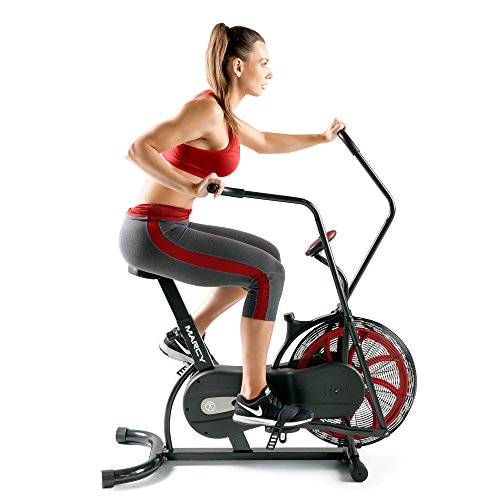
Marcy Fan Exercise Bike with Air Resistance System – Red and Black – NS-1000
Included for 'Best Assault Bikes' because the listing specifies Red and Black and NS-1000, details this guide uses to compare options.
View on Amazon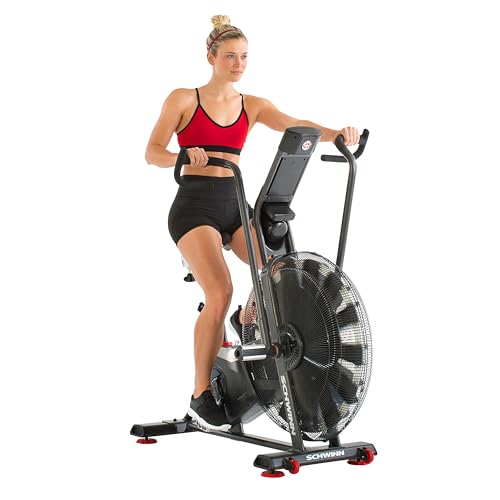
Schwinn Fitness AD7 Airdyne Bike
Included for 'Best Assault Bikes' as a relevant option in this category; details come from the product listing.
View on Amazon
Sunny Health & Fitness Smart Heavy-Duty Fan Bike for HIIT Cycling Workout
Included for 'Best Assault Bikes' as a relevant option in this category; details come from the product listing.
View on AmazonBest assault bikes compared
| Bike | Approx. dimensions | Bike weight | Resistance and fan | Console metrics | Noise and feel |
|---|---|---|---|---|---|
| Rogue Echo Bike 3.0 | 55 x 29 x 52 in | 127 lb | Chain-driven, 25-in fan | Time, intervals, distance, calories, watts, RPM, heart rate | Very stable; loud, forceful airflow and a heavy sprint feel |
| AssaultBike Classic | About 51 x 23 x 48 in | About 95 lb | Chain-driven, large air fan | Time, intervals, distance, calories, watts, RPM, heart rate | Responsive and relatively compact; mechanical fan and chain noise |
| AssaultBike Pro X | About 51 x 23 x 48 in | About 125 lb | Belt-driven, large air fan | Expanded interval and performance data, depending on console version | Smoother and quieter than the Classic; heavier, more planted frame |
| Schwinn Airdyne AD7 | About 53 x 26 x 53 in | About 113 lb | Belt-driven, 26-in fan | Time, distance, calories, watts, RPM and interval functions | Smooth pedaling with substantial airflow; broad footprint |
| Concept2 BikeErg | 48 x 24 x 38 in | About 58 lb | Air-resistance flywheel, not a full-body fan bike | PM5: watts, pace, cadence, distance, calories, heart rate and intervals | Quieter and more precise; no arm handles or whole-body push-pull motion |
Dimensions and weights are approximate published figures and can vary slightly by revision, accessories and measurement method. Allow extra clearance around every bike for moving handlebars, mounting and safe dismounting.
Our picks by situation
| Your situation | Best choice | Why |
|---|---|---|
| Lowest sensible entry cost | AssaultBike Classic | Provides the familiar full-body fan-bike experience without the mass and price of premium commercial models. |
| Heavy sprint intervals and shared gym use | Rogue Echo Bike 3.0 | The 127-lb frame and wide base resist rocking when standing, pulling and accelerating hard. |
| Frequent training with a smoother drivetrain | AssaultBike Pro X | The belt drive reduces chain maintenance and gives a less rattly feel during repeated sessions. |
| Longer mixed conditioning sessions | Schwinn Airdyne AD7 | Its large fan supplies strong airflow, while the belt drive makes the stroke feel smooth. |
| Small room, measurable pacing and lower noise | Concept2 BikeErg | It is lighter and shorter, and the PM5 makes repeatable watt-based intervals easier to execute. |
Head-to-head: what changes between the leading designs?
Rogue Echo Bike 3.0 vs AssaultBike Classic
Both deliver the unmistakable fan-bike workout: the pedals, handles and fan accelerate together, and there is no fixed resistance level to select. The Echo Bike is the better choice when frame stability matters more than easy relocation. Its broad, heavy chassis stays composed during all-out efforts, but it takes more floor space and is awkward to carry up stairs.
The AssaultBike Classic is easier to fit into a home gym and usually costs less. Its chain drivetrain has a direct, gritty response that many people like for short intervals, though it requires more attention to lubrication and tension. For a garage or dedicated training area, the Echo’s extra mass is useful. For a shared room or occasional use, the Classic is easier to live with.
AssaultBike Pro X vs Schwinn Airdyne AD7
The Pro X and AD7 are the better belt-driven options in this group. A belt generally produces less drivetrain rattle than a chain and avoids routine chain lubrication. The AD7 has a particularly large fan and a noticeable cooling effect, which is welcome during longer sessions. The Pro X is a stronger fit for buyers who prefer Assault Fitness’s interval-oriented layout and a heavier, more commercial-feeling frame.
Neither is quiet in the way an indoor cycling bike is quiet. The fan remains the main sound source, and room acoustics can make the noise seem considerably louder than the drivetrain itself.
Fan bike vs Concept2 BikeErg
The BikeErg is not a direct substitute for an assault bike. It has no moving handles, so it trains leg drive and cycling cadence rather than coordinated upper- and lower-body pushing and pulling. In return, it offers a more controlled riding position, a smaller footprint and excellent pacing feedback through the PM5 monitor.
Choose a fan bike for short, aggressive intervals and full-body conditioning. Choose the BikeErg when you want repeatable watt targets, longer rides, lower noise and a familiar cycling motion.
How to choose resistance feel and console metrics
- For all-out sprints: favor a heavy frame and immediate air resistance. The Echo Bike and Pro X are particularly suitable.
- For classic 10-round interval workouts: choose a console with programmed work and rest periods, elapsed time, calories, RPM and watts.
- For comparing sessions over months: watts, distance and cadence are generally more useful than calories, because calorie estimates depend on body size, effort and the console’s calculation.
- For heart-rate-guided training: confirm that the console supports your preferred chest strap or wireless sensor. Compatibility can differ by console revision.
- For a smoother feel: select a belt-driven bike or the BikeErg. A chain-driven bike is not inferior, but it tends to sound more mechanical and needs more drivetrain care.
Footprint, clearance and setup
Do not measure only the bike’s published length and width. A rider needs room to approach the seat, and the handlebars need unobstructed movement. A practical starting point is at least 24 inches of clear space on each side and roughly 36 inches in front of the fan, then more if several people will use the bike.
Seat height is correctly set when the knee retains a slight bend at the lowest pedal position. If the hips rock from side to side, lower the seat or reduce the reach before increasing intensity. The handlebars should allow the shoulders to stay relaxed rather than forcing the rider to lock the elbows.
Place the bike on a firm, level surface. A dense rubber mat protects flooring, reduces vibration and makes it easier to notice loose hardware. It will not make a large fan silent.
Ownership realities: what wears first
- Fan and frame: inspect the fan guard, welds, stabilizer feet and transport wheels. A bent guard can rub against the fan and create noise.
- Chain-driven models: clean and lightly lubricate the chain at the interval recommended by the manufacturer. Over-oiling attracts grit.
- Belt-driven models: keep the belt and pulleys free of sweat and dust. Do not apply chain lubricant to a belt.
- Pedals and crank hardware: check them periodically, especially if users stand on the pedals. Loose crank or pedal threads can become expensive to repair.
- Seat and grips: these are normal wear items. Sweat, abrasive clothing and frequent adjustment shorten their life.
- Console power: remove batteries during long storage if the manual permits it, and wipe sweat from the display and buttons after training.
A common mistake is treating every interval as a maximum-effort sprint. That makes pacing inconsistent and can cause the final rounds to collapse. For example, in a 10-round workout with 20 seconds of work and 100 seconds of recovery, begin at an intensity you can repeat for all 10 rounds. Record average watts, calories or distance rather than chasing a single spectacular first interval.
Bottom line
Buy the Rogue Echo Bike 3.0 if stability and hard sprint work are the priorities. Choose the AssaultBike Classic for a more compact and usually more economical entry into full-body air-bike training. Step up to the AssaultBike Pro X or Schwinn Airdyne AD7 for a smoother belt-driven experience. If your priorities are lower noise, precise pacing and cycling rather than arm-driven conditioning, the Concept2 BikeErg is the better decision—even though it is not technically an assault bike.