Key takeaways
- One wheel: Best for turning around shrubs, gates, and narrow beds. The operator supports much of the load, so it demands more balance and strength.
- Two wheels: Easier to keep level and less likely to tip while loading. Steering is less precise, especially on a tight or sloped path.
- Four wheels: Usually the most stable option for bulky loads. A garden cart can be easier to pull, but it needs more turning space and does not pivot like a single-wheel barrow.
The best garden wheelbarrows match their tray size, wheel layout, and handle shape to your ground and load: choose a single-wheel steel barrow for tight, uneven beds; a two-wheel poly cart for easy balance; or a heavy-duty garden cart when stability matters more than precise steering.
Quick picks by gardening situation
| Situation | Best choice | Why it fits | Typical budget |
|---|---|---|---|
| Small yard, narrow paths, occasional jobs | 4–6 cu. ft. single-wheel barrow | Turns tightly and stores vertically | $60–$130 |
| Frequent mulch, compost, or soil hauling | 6–8 cu. ft. steel or poly barrow | Fewer trips without becoming excessively wide | $100–$220 |
| Uneven ground or a new gardener | Two-wheel poly wheelbarrow or garden cart | More stable and less tiring to balance | $90–$250 |
| Very heavy materials and repeated use | Heavy-duty steel barrow or four-wheel garden cart | Stronger frame, larger tires, and greater load margin | $180–$400+ |
What to compare before buying
Tray capacity and useful load
Manufacturers commonly describe wheelbarrow trays in cubic feet. A 4-cubic-foot tray suits routine weeding, hand tools, and smaller loads. A 6-cubic-foot model is the most versatile size for many homeowners, while an 8-cubic-foot tray reduces trips during large planting or mulching projects.

Garden Star 70019 Garden Barrow Dual-Wheel Residential Wheelbarrow Garden Cart
Included for 'Best Garden Wheelbarrows for Moving Soil, Mulch, and More' as a relevant option in this category; details come from the product listing.
View on Amazon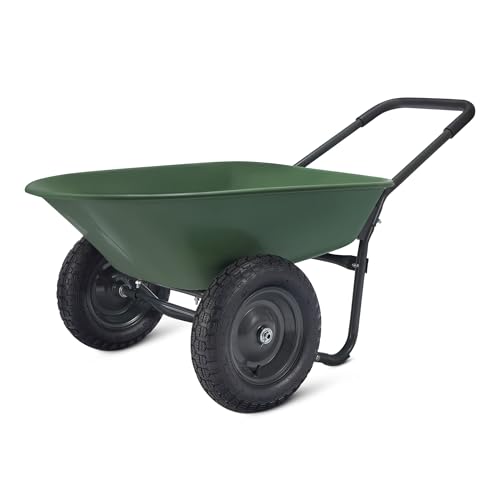
Amazon Basics Garden Wheelbarrow, Heavy Duty, 330 Pounds Capacity, 3.7 Cubic Feet, 26.8W x 53.9D x 27.2H inches, Green, 1-Pack
Included for 'Best Garden Wheelbarrows for Moving Soil, Mulch, and More' because the listing specifies Heavy Duty and 330 Pounds Capacity, details this guide uses to compare options.
View on AmazonCapacity is not the same as safe carrying weight. One cubic foot of dry mulch may weigh roughly 15–30 pounds, while moist topsoil can weigh 70–100 pounds or more. A full 6-cubic-foot soil load could therefore exceed 400 pounds, far beyond the practical limit of many residential barrows. For dense materials, fill the tray only partway and follow the manufacturer’s load rating.
As a worked example, moving 1 cubic yard of mulch requires 27 cubic feet. A 6-cubic-foot barrow filled to about 80% carries 4.8 cubic feet, so the job takes approximately six loads. A smaller 4-cubic-foot barrow filled to the same level carries 3.2 cubic feet and requires about nine loads. The larger barrow saves three trips, but only if its width and weight remain manageable on your path.
Wheel count and maneuverability
- One wheel: Best for turning around shrubs, gates, and narrow beds. The operator supports much of the load, so it demands more balance and strength.
- Two wheels: Easier to keep level and less likely to tip while loading. Steering is less precise, especially on a tight or sloped path.
- Four wheels: Usually the most stable option for bulky loads. A garden cart can be easier to pull, but it needs more turning space and does not pivot like a single-wheel barrow.
A single pneumatic tire rolls well over grass and loose soil because it absorbs bumps. It can, however, lose pressure or develop a puncture. A flat-free tire avoids those problems but may transmit more vibration and feel harder to push across ruts. Two-wheel designs often use smaller tires, so check that they have enough clearance to avoid scraping the frame or tray.
Tray material and frame construction
Steel trays resist abrasion from rocks, gravel, and rough tools. They are a good choice for construction debris and repeated use, but bare or chipped steel can rust. Look for a painted, powder-coated, or galvanized finish, and avoid leaving water or wet soil sitting in the tray.
Poly trays are lighter, quiet, and resistant to rust. They are especially convenient for compost, mulch, and general garden work. Their weaknesses are gouging from sharp stones and possible cracking after years of ultraviolet exposure or impact in cold weather. A thick, molded tray with a supported underside is preferable to a very thin one.
The frame matters as much as the tray. Tubular steel supports and a cross-brace beneath the tray reduce flex when lifting. Inspect the junction where the handles meet the front wheel bracket: looseness there makes a loaded barrow feel unstable and is often an early sign of failure.
Handle design and operator fit
Traditional straight handles give good leverage for tipping, but the correct spacing and height are important. When standing behind the empty barrow, you should be able to grip the handles without hunching or reaching excessively. Handles that are too low place more strain on the back; handles that are too far apart make steering awkward.
Loop or ergonomic handles can make lifting and dumping easier by offering several grip positions. They can also be more comfortable for users with smaller hands. Check the clearance around the grips if you wear gloves, and look for nonslip coverings that will not become loose after repeated wet use.
Head-to-head: the main wheelbarrow types
| Type | Typical tray | Typical load rating | Approximate empty weight | Ground performance |
|---|---|---|---|---|
| Single-wheel steel barrow | 5–6 cu. ft. | 300–600 lb | 35–55 lb | Excellent turning; can tip on side slopes |
| Single-wheel poly barrow | 4–6 cu. ft. | 250–500 lb | 25–45 lb | Light and quiet; less resistant to sharp debris |
| Two-wheel barrow | 5–7 cu. ft. | 300–600 lb | 35–65 lb | Stable on level ground; wider turning circle |
| Four-wheel garden cart | 7–12 cu. ft. | 600–1,200 lb | 45–100 lb | Stable and high-capacity; needs room to turn |
These are useful comparison ranges rather than universal ratings. Actual capacity depends on the frame, axle, tire, tray shape, and manufacturer’s instructions. Never treat a high-volume tray as permission to carry a full load of wet soil.
Choosing between popular designs and established brands
Brands such as Jackson and True Temper offer traditional single-wheel wheelbarrows in steel and poly versions, making them sensible choices when maneuverability and repairable, familiar construction matter. Their basic formats are easy to understand: compare tray depth, tire type, handles, and the stated load rating rather than focusing only on volume.
Gorilla Carts is known for two-wheel and four-wheel garden carts with larger capacities and pull-style designs. These are worth considering for hauling firewood, bags of soil, or multiple containers across relatively open ground. Their stability comes at the cost of a wider footprint and less nimble steering.
The WORX Aerocart takes a convertible approach, combining a compact wheelbarrow format with accessories and alternate carrying configurations. It can suit gardeners who have limited storage and want one tool for several light-duty tasks, although a conventional steel barrow is usually the simpler choice for repeatedly moving dense loads.
Ownership realities: what wears out first
- Tube and tire: Pneumatic tires eventually lose air, and inner tubes can puncture. Keep a pump available and check pressure before heavy work.
- Wheel bearings or bushings: Dirt and water can cause a wheel to wobble. Clean the axle and replace worn hardware rather than continuing with a loose wheel.
- Fasteners: Vibration gradually loosens bolts at the wheel bracket, handles, and tray supports. Check them at the start of each season.
- Tray finish: Steel rust begins where paint is chipped. Rinse corrosive fertilizer residue, dry the tray, and touch up exposed metal.
- Legs and nose plate: Dropping a barrow heavily onto its front can bend the legs or nose. Lower the load under control instead of using the tray as a lever.
Do not store a wheelbarrow with waterlogged soil inside. Empty it, rinse off fertilizer and compost residue, and stand it under cover or upside down where practical. Lubricate the axle according to the manufacturer’s instructions, but keep lubricant away from tire rubber and handle grips.
A practical buying checklist
- Measure the narrowest gate and path. Choose a barrow whose widest point is at least 2 inches narrower, allowing room to steer.
- Estimate the densest material you will carry. If that is wet soil or stone, prioritize the load rating and frame over maximum tray volume.
- Choose pneumatic tires for rough ground and flat-free tires for low maintenance.
- Stand behind the handles and check that your wrists remain neutral and your back does not need to bend sharply.
- Confirm that replacement tubes, tires, wheel hardware, and bolts are available before buying an unusual design.
- Compare folded or upright storage dimensions if the barrow must fit in a shed or garage.
Bottom line
For most mixed garden work, the best garden wheelbarrows are 5–6-cubic-foot models with a strong frame, a single pneumatic or quality flat-free wheel, and handles that fit your height. Select a two-wheel poly design when balance and easy loading are more important than tight turning, or move up to a four-wheel garden cart for large, heavy loads on open, reasonably level ground. The right choice is not the biggest tray: it is the model you can safely load, steer, maintain, and store.