Key takeaways
- 1–2 acres: A 42- to 48-inch deck is usually easier to place around trees, gardens, and gates.
- 2–4 acres: A 48- to 54-inch deck is often the best balance between maneuverability and mowing time.
- 4 or more open acres: A 54- to 60-inch deck can reduce mowing time, provided the terrain is not heavily obstructed.
- Hilly or irregular ground: Favor traction, a lower center of gravity, and a deck that follows the terrain over maximum width.
Best Garden Tractors for Large Lawns and Heavy-Duty Yard Work
The best garden tractors for large lawns are the John Deere X570 for all-around mowing and attachments, the Cub Cadet XT3 GSX for heavy-duty residential work, the Husqvarna TS 354XD for wide-area mowing, and the Simplicity Broadmoor for terrain-following cut quality. Your acreage, slopes, towing needs, and preferred attachments matter more than maximum horsepower.
Quick comparison: the leading choices
| Model | Engine and transmission | Deck width | Turning circle | Best use | Typical 2026 market range |
|---|---|---|---|---|---|
| John Deere X570 | 24 hp V-twin; hydrostatic | 48 or 54 inches | Approximately 22 inches | Large lawns, snow clearing, towing, seasonal attachments | $8,000–$11,000 |
| Cub Cadet XT3 GSX | 25 hp V-twin; hydrostatic | 48 or 54 inches | Approximately 16 inches | Heavy mowing, carts, front blades, demanding residential use | $6,500–$9,000 |
| Husqvarna TS 354XD | 24 hp V-twin; pedal-operated hydrostatic | 54 inches | Approximately 16 inches | Open lawns where mowing speed and width matter | $5,000–$7,000 |
| Simplicity Broadmoor | 23–25 hp V-twin; hydrostatic | 44 or 52 inches | Approximately 20 inches | Uneven ground and a refined, consistent finish | $7,000–$10,000 |
Specifications can vary by model year, deck configuration, and dealer package. Confirm the exact deck, hitch, lift system, and attachment drive before buying.

Husqvarna TS 375XD Riding Lawn Mower 24Hp 54 inches Deck Differential Lock 970847301
Included for 'Best Garden Tractors for Large Lawns and Heavy-Duty Yard Work' as a relevant option in this category; details come from the product listing.
View on Amazon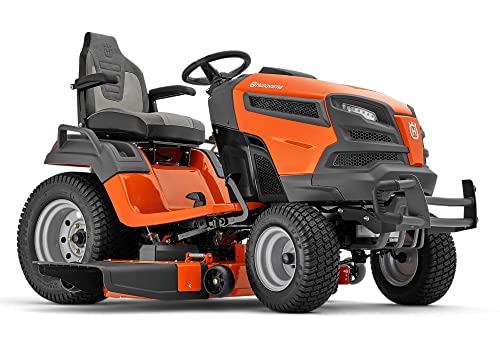
Husqvarna Riding Lawn Mower 24Hp 54 inches Deck Differential Lock
Included for 'Best Garden Tractors for Large Lawns and Heavy-Duty Yard Work' as a relevant option in this category; details come from the product listing.
View on AmazonOur picks by situation
Best overall: John Deere X570
The X570 is a strong choice when one tractor must mow, tow, move snow, and accept useful seasonal equipment. Its 24-horsepower V-twin has sufficient reserve for a 48- or 54-inch deck, a loaded utility cart, or a snowblower under normal residential conditions. The hydrostatic transmission is easy to control, and the tractor uses a sturdier frame and heavier-duty chassis than typical lawn tractors.
Its advantage is not simply engine output. John Deere’s attachment ecosystem, power-lift options, front hitch arrangements, and dealer support make it easier to build a year-round setup. The trade-off is cost: the tractor and proprietary attachments can put total ownership well above a basic lawn tractor.
Best for demanding yard work: Cub Cadet XT3 GSX
The XT3 GSX is aimed at owners who routinely tow, mulch, haul, or mow thick growth. Its 25-horsepower V-twin and garden-tractor chassis provide useful pulling capacity, while the hydrostatic transmission gives precise speed control around trees and landscaping. A tight turning circle is particularly helpful on lawns with many obstacles.
Choose the 48-inch deck if your property has gates, narrow passages, or frequent obstacles. The 54-inch deck is faster on open ground, but it requires more clearance and can be less convenient around beds and fences. The XT3 is also a sensible platform for a rear cart, spreader, front blade, or snow equipment, provided the attachment is approved for the exact configuration.
Best for open acreage: Husqvarna TS 354XD
The TS 354XD makes the most sense when mowing is the primary task and the lawn has broad, relatively open sections. Its 54-inch fabricated deck reduces the number of passes, and the 24-horsepower V-twin is appropriate for regular mowing of several acres. The pedal-operated hydrostatic control leaves both hands available for steering and managing the deck.
This is a mowing-focused choice rather than the most versatile year-round garden tractor. Before buying, check whether the available snowblower, front blade, bagger, hitch, or tow-behind equipment fits the exact tractor. A wide deck is valuable only if gates, shed doors, and storage areas can accommodate it.
Best for uneven lawns: Simplicity Broadmoor
The Broadmoor stands out for its suspension and deck design, which are intended to help the mower follow rolling ground rather than scalp high spots. That can produce a better finish on uneven lawns than a rigid, inexpensive deck. It is a good fit for owners who care about cut quality but still want a conventional riding tractor instead of a zero-turn mower.
The 44-inch deck is easier to maneuver and may leave fewer uncut strips around landscaping. The 52-inch option improves productivity on open sections. Simplicity’s attachment availability and local dealer support should be checked carefully, especially if snow removal is a major reason for the purchase.
How to match deck width to your property
Deck width is a productivity decision, not just a measure of cutting power. A wider deck covers more ground per pass, but it needs more room to turn and can be awkward in narrow areas.
- 1–2 acres: A 42- to 48-inch deck is usually easier to place around trees, gardens, and gates.
- 2–4 acres: A 48- to 54-inch deck is often the best balance between maneuverability and mowing time.
- 4 or more open acres: A 54- to 60-inch deck can reduce mowing time, provided the terrain is not heavily obstructed.
- Hilly or irregular ground: Favor traction, a lower center of gravity, and a deck that follows the terrain over maximum width.
For a simple estimate, divide the mowing area by the deck width and multiply by an efficiency factor that accounts for overlap and turning. A 3-acre lawn contains about 130,680 square feet. A 54-inch deck is 4.5 feet wide, so its theoretical coverage is 4.5 times the tractor’s travel distance. At an effective mowing speed of 3.5 miles per hour and 75 percent field efficiency, the calculation is approximately:
3.5 × 5,280 × 4.5 × 0.75 ÷ 43,560 = about 2.25 acres per hour.
In real use, slopes, wet grass, obstacles, and clipping conditions may reduce that figure. The same property could take roughly 80 minutes of mowing rather than the theoretical 45 to 50 minutes suggested by width alone.
Transmission and turning performance
Nearly all tractors in this class use hydrostatic transmissions. They let you vary speed without clutching or shifting, which is useful when approaching trees, reversing toward a trailer, or slowing in thick grass. A pedal-operated system is convenient for frequent speed changes; a hand lever can offer equally precise control but may require more arm movement.
A tight turning circle saves time on an obstacle-filled lawn, but it does not make a tractor a zero-turn mower. For steep slopes, controlled low-speed operation and traction are more important than the smallest advertised turning radius. Avoid sudden downhill turns, keep the deck low enough for stability, and follow the manufacturer’s slope guidance.
Attachment compatibility: check the complete system
Do not assume that a tractor can power every attachment in a brand’s catalog. Check four points before purchase:
- Mounting system: Some front blades, snowblowers, and brooms require a dedicated front hitch or subframe.
- Power source: A mechanical PTO, electric clutch, or belt-drive arrangement may be required, and not every tractor supports all three.
- Lift capacity: Rear implements and loaded carts can exceed the tractor’s intended capacity, especially on slopes.
- Traction equipment: Snow chains, wheel weights, and a rear ballast system may be necessary for safe winter work.
For occasional hauling, a tow-behind cart is usually simpler than a front loader. A garden tractor is not automatically a compact utility tractor: its hitch and frame may be suitable for a cart, spreader, aerator, or blade but not for lifting heavy soil or pallets.
Ownership realities that affect the best choice
The parts that commonly wear first are blades, deck belts, idler pulleys, tires, battery terminals, and steering components. Wet grass accelerates deck corrosion and leaves packed under the shell, while neglected belts can slip and overheat. After each wet mowing session, remove accumulated debris safely, inspect the belt path, and avoid directing high-pressure water at bearings, electrical connectors, or the transmission.
Plan on sharpening or replacing blades at least annually, more often when mowing sandy soil or rough ground. Change engine oil and filters at the interval specified for the engine, keep the cooling screens clear, and lubricate deck spindles and pivot points where the manual calls for it. Fuel stabilizer is worthwhile when the tractor will sit through winter.
A common mistake is buying the widest deck that fits the horsepower rating, then discovering that the tractor cannot pass through the gate or safely negotiate the property. Measure the narrowest opening, storage door, trailer ramp, and turning area before choosing a 54-inch model.
Final buying recommendation
Choose the John Deere X570 if attachment support and long-term versatility are priorities. Pick the Cub Cadet XT3 GSX for frequent heavy residential work and tight maneuvering. Choose the Husqvarna TS 354XD when fast mowing across open acreage is the main job. Select the Simplicity Broadmoor when uneven ground and finish quality matter most.
Whichever tractor you select, prioritize the correct deck width, adequate traction, a transmission you can control comfortably, and confirmed compatibility with the attachments you will actually use. Those choices will affect productivity and ownership satisfaction more than a small difference in advertised horsepower.