Key takeaways
- Table of Contents 7 sections 11 min read 1 Quick Verdict 2 Side by Side 3 Where Rechargeable Wins 4 Where Battery Headlamp Wins 5 Cost Over 5 Years 6 Which One for Your Home 6.1 Small Apartment 6.2 Family…
What's inside
If you are shopping for a headlamp for use around the house, the choice between rechargeable vs battery headlamp comes down to more than just how it powers on. For home use in 2026, you are not picking a light for a single expedition, you are picking a tool you will grab during a power outage, while fixing a leaky sink under the cabinet, crawling into the attic, or walking the dog after dark. One option offers convenience and lower long-term cost if you remember to charge it. The other offers grab-and-go reliability if you prefer to swap cells and be done. Here is how they actually compare for everyday home ownership.
Quick Verdict
Choose a rechargeable headlamp if you use a headlamp weekly, want the lowest cost over time, and do not mind plugging it in after use. Most modern rechargeable models run on a built-in lithium-ion pack or a removable 18650 cell, charge via USB-C in 2 to 4 hours, and deliver 300 to 800 lumens for 4 to 10 hours on medium.
As an Amazon Associate we earn from qualifying purchases at no extra cost to you. Product prices and availability are accurate as of the date shown and are subject to change.




Choose a battery headlamp if you want maximum readiness with minimal upkeep, prefer to store the light for months between uses, or want to keep spares on hand without thinking about charging. Battery models that run on 3x AAA cells are especially simple: when the beam dims, swap batteries in under 30 seconds and you are back at full brightness. For infrequent users, renters, and emergency-kit builders, that simplicity often wins.
For many households, the practical answer is to own one rechargeable for regular chores and keep a budget battery model as a backup in the junk drawer or emergency kit.
Side by Side
| Feature | Rechargeable Headlamp | Battery Headlamp (AAA/AA) |
|---|---|---|
| Comfort | Lightweight at 1.6 to 3.2 oz without separate battery pack; balanced weight on forehead; elastic bands are often wider and more adjustable | Slightly heavier at 2.5 to 4.5 oz with 3x AAA loaded; weight centered on front; basic elastic strap, comfortable for 1 to 2 hours |
| Durability | Sealed housing, IPX4 to IPX6 water resistance; lithium cell rated for 300 to 500 cycles before capacity drops to 80 percent | Simple electronics, IPX4 to IPX5 water resistance; no charging port to fail; survives long storage if batteries are removed |
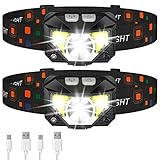
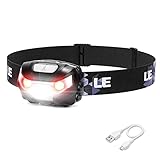
| Price Range | $18 to $55 for quality home-use models; premium models with sensors and high output run $60 to $90 | $12 to $25 for 2-packs like the Eirnvop 2000 Lumen 9 LED Headlamp 2 Pack or Lepro Headlamp Battery Powered Waterproof LED Headlight 2 Pack; single units $9 to $20 |
| Maintenance | Recharge after every 2 to 3 uses; check USB port cover; store at 40 to 60 percent charge for long-term health | Swap batteries when dim; remove batteries if storing more than 30 days to prevent corrosion; no cables needed |
| Space Needed | Headlamp plus short USB-C cable; stores in a drawer; no extra battery organizer required | Headlamp plus spare batteries; a small 4×6 inch organizer for AAA/AA spares keeps the drawer tidy |
| Look | Low-profile, modern housing; often matte black or gray with integrated battery indicator | Slightly bulkier front housing to fit the battery carrier; classic utilitarian look |
| Resale | Low resale value, $5 to $15 used; buyers ask about battery health | Very low resale value, sold as bundles; better to keep as a spare than resell |
| Best For | Frequent use, workshops, garages, nightly dog walks, hands-free home repairs | Emergency kits, occasional use, rentals, and households that prefer disposable-cell simplicity |
Where Rechargeable Wins
Rechargeable headlamps are built for regular use, and that is where they make the most sense at home. Instead of buying cells, you plug in. A typical built-in 1200mAh lithium-ion battery delivers about 350 lumens on high for 3 to 5 hours and 80 to 150 lumens on medium for 8 to 12 hours, which covers most tasks from painting a closet to working under a kitchen sink.
Cost and waste are the biggest advantages. If you use your headlamp for 4 hours per week, you will cycle the battery about 25 to 30 times per year. Over five years that is well within the 300 to 500 cycle life, so you may never need to replace the pack. You also avoid a steady stream of alkaline AAA purchases. The light itself is usually more efficient, with regulated output that holds brightness steady until the battery is low, rather than gradually dimming.
Performance features also lean toward rechargeable. You will find red-light modes for late-night checks without waking the house, stepless dimming, motion sensors for hands-free on/off when your hands are greasy, and battery indicators that show 25, 50, 75, and 100 percent. Charging is straightforward. Most models reach full charge in 2.5 to 3.5 hours from a standard 5V 1A USB port and can top off from a laptop, power bank, or wall adapter you already own.
For homeowners who like a streamlined setup, rechargeable means fewer small parts. There is no battery carrier to snap open in the dark and no hunting for the right cell size. For a workshop bench or utility closet where the headlamp lives on a hook, that one-cable routine is easy to maintain.
Where Battery Headlamp Wins
Battery headlamps win on readiness and simplicity, especially if you do not use a headlamp every week. An alkaline or NiMH AAA cell holds its charge for months, so a headlamp stored in a hallway closet will still turn on when the power goes out. You do not need to remember to top it up. If the beam fades, you swap cells and get instant full brightness again, which is faster than waiting for a recharge during an outage.
This category is also the budget king for households that want coverage in multiple places. Value packs keep the price low. The Eirnvop 2000 Lumen 9 LED Headlamp 2 Pack at $16.99, with 6 AAA Batteries Included, gives you a light for the garage and one for the emergency kit for less than most single rechargeable units. The Lepro Headlamp Battery Powered Waterproof LED Headlight 2 Pack at $15.99 follows the same logic: two lights, IPX-rated housing, and no charger to keep track of.
If you prefer rechargeable cells without committing to a built-in pack, standard NiMH AA or AAA batteries bridge the gap. Options like the Amazon Basics 24-Pack Rechargeable AA NiMH Batteries at $20.83 or the Amazon Basics 8-Pack Rechargeable AA NiMH Batteries at $10.49, both rated at 2000 mAh, 1.2V, low self-discharge and up to 1000 recharges, let you recharge on your own schedule while keeping the convenience of swappable cells. You can keep a charged set in the drawer and rotate them between the headlamp, remote controls, and kids toys.
Battery models also handle long idle periods better. With lithium-ion, storing a pack at 100 percent for a year can accelerate capacity loss, and storing it dead can prevent it from turning on at all. With a battery headlamp, you simply remove the cells if you will not use it for a month or more and avoid any corrosion risk or parasitic drain.
Cost Over 5 Years
For home use, assume moderate use: 3 hours per week, or about 150 hours per year. Here is how the math typically breaks down.
Rechargeable headlamp: Upfront cost $25 to $45 for a solid mid-range model. Electricity cost is negligible, roughly $0.30 to $0.60 per year to recharge a 3 to 5 watt-hour pack weekly. Over five years you spend $25 to $46 total, and you generate almost no battery waste. If the built-in battery needs replacement after year 4, add $10 to $18 for a compatible 18650 cell where the design allows it.
Battery headlamp with disposable alkaline AAA: Upfront cost $13 to $22 for the light. Runtime on 3x AAA alkaline at 150 lumens is 6 to 10 hours per set. At 150 hours per year, you will use 15 to 25 sets, or 45 to 75 AAA cells. At $0.35 to $0.55 per alkaline AAA, that is $16 to $41 per year in cells, or $80 to $205 over five years. Total five-year cost lands around $93 to $227.
Battery headlamp with rechargeable NiMH AA/AAA: Upfront cost $13 to $22 for the light plus $10.49 to $20.83 for Amazon Basics Rechargeable NiMH batteries and $12 to $18 for a basic charger if you do not own one. Cell cost per year drops to near zero after the first purchase, with each cell good for hundreds of cycles. Five-year total is $35 to $61, very close to a built-in rechargeable setup, with the added flexibility of using the cells in other devices around the house.
If you only use a headlamp 10 to 20 hours per year for emergencies, disposable cost shrinks to $4 to $8 per year, so the cheapest 2-pack on alkaline cells can still be the most economical short-term choice.
Which One for Your Home
The right pick depends on how you live in your space and how often you will actually reach for the light.
Small Apartment
Space is tight and you likely own one good headlamp instead of several. A compact rechargeable model is ideal. It hangs on a single hook in a closet, needs no spare-battery bin, and charges from the same USB-C cable you use for your phone. Look for a 45 to 65 gram model with a 40 to 60 degree tilt, 3 to 6 modes, and a red-light option so you can check a breaker panel at night without flooding a studio with light.
Family with Kids or Pets
Durability and instant readiness matter more than ultralight design. Kids will leave a light on, pets will knock it off a table, and you will need it fast when a storm trips the power. Consider a battery headlamp 2-pack so you have one ready while the other is in use, or use a battery model powered by rechargeable NiMH cells that you can swap in seconds. Choose a model with a simple push-button interface, IPX5 rating for spills, and a headband that adjusts from 20 to 24 inches to fit adults and older kids.
Rental
Renters often cannot install hardwired task lighting and rely on portable solutions for closets, under-sink repairs, and balconies. A battery headlamp is the low-commitment workhorse. It moves with you, requires no charging habit between apartments, and is cheap enough to replace if lost during a move. Keep a small zip pouch with the headlamp and 6 spare AAA cells in your toolbox so you are ready on move-in day without hunting for a charger.
Long-Term Home
For a home you plan to stay in for years, a rechargeable headlamp is the best primary. You will use it for attic insulation checks, crawlspace inspections, garage projects, and evening yard work, so the lower running cost and steady regulated brightness pay off. Invest $30 to $50 in a model with USB-C, 500 to 800 lumens max, and 4 to 6 hour runtime on medium. Keep a budget battery model as a backup in your emergency kit with the batteries removed, so you have coverage even if the rechargeable was left uncharged in the workshop.
FAQ
Are rechargeable headlamps brighter than battery headlamps?
Not always, but rechargeable models usually sustain brightness better. Both types can list 300 to 1000 lumens on the box, but rechargeable lights with a lithium-ion cell and regulated driver hold that output flat for most of the run time, then step down. Alkaline AAA models tend to dim gradually as voltage drops. For close-up home tasks, 100 to 200 lumens is plenty, and both types deliver it easily.
How long does a headlamp last before it needs replacement?
The LED itself can last 30,000 to 50,000 hours. What limits service life is the power system and the headband. Elastic bands stretch after 2 to 4 years of regular use, and built-in lithium packs lose about 20 percent capacity after 300 to 500 full cycles. Battery models last as long as the housing and switch hold up, often 5 to 8 years if you remove cells during storage.
Can I use rechargeable batteries in a battery headlamp?
Yes, if the headlamp specifies AAA or AA size, you can use 1.2V NiMH rechargeable cells like the Amazon Basics Rechargeable AA NiMH Batteries. Expect slightly lower max brightness compared to 1.5V alkaline on some models, but longer stable output on medium and much lower cost per hour. Check the manual for compatibility, and do not mix alkaline and NiMH in the same carrier.
What should I keep in a home emergency kit?
Keep at least one headlamp with fresh cells, plus 6 to 12 spare AAA or AA batteries in a cool, dry place. If you rely on a rechargeable headlamp daily, add a battery backup model with cells removed and wrapped nearby so you have light even during an extended outage when charging is not possible. A 70 to 120 lumen medium mode that runs 8 to 15 hours is more useful in an outage than a short burst at 600 lumens.