Key takeaways
- Pro: Universally compatible with nearly any frame thanks to the 16-28 inch wheel range
- Pro: Lowest entry cost in this roundup by a wide margin
- Con: Brushed motor and controller are loud, wear faster, and struggle on any meaningful grade
What's inside
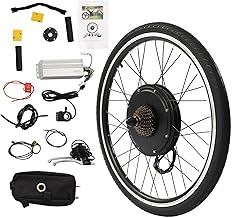
Most people I talk to at the shop already own a bike they like. It sits in the garage, the frame is solid, the geometry fits, and replacing it with a new e-bike that costs three or four times more simply doesn’t make sense. A conversion kit solves that problem. You keep the bike you trust, add a motor to one or both wheels, and hills stop being an excuse to stay home. The catch is that this market is flooded with kits that look identical in product photos but differ wildly in controller reliability, sensor accuracy, and how well they integrate with an older frame never designed to handle motor torque.
After installing and riding enough of these to fill a spreadsheet, I can tell you that the cheapest units will let you down on the first wet ride, while the expensive ones sometimes over-promise for a commuter who just needs flat assist on a neighborhood loop. The best electric bike conversion kits for older bikes land in the middle: enough power for real-world use, components that survive a year of daily commuting, and instructions that don’t assume you own a torque wrench and a multimeter already. This roundup ranks eight options by how they actually behave once bolted to a frame that’s been in service for a while.
As an Amazon Associate we earn from qualifying purchases at no extra cost to you. Product prices and availability are accurate as of the date shown and are subject to change.




Quick Picks
| Product | Best For | Price |
|---|---|---|
| Electric Bicycle Motor Kit 24V 250W | Ultra-low-budget experiments | $49.99 |
| LYNICESHOP 24V 250W | Reliable light assist on smaller wheels | $61.29 |
| 48V 1000W/1500W Rear & Front Hub | Dual-motor setups for heavy riders | $189.99 |
| Ebike Conversion Kit 48V 1000W 20″ | Small-wheel and folding bike conversions | $110.32 |
| Electric Bike Conversion Kit 48V 1000W 26″ | Daily commuting on standard 26″ wheels | $119.99 |
| 26 Inch 48V 1000W Rear Wheel Kit | Simple rear-wheel swap on mountain bikes | $119.99 |
| LIVALL PikaBoost 2 | Zero-permanent-modification commuters | $349 |
| 26 Inch 72V 2000W Rear Hub Kit | Speed-focused riders needing high power | $182.88 |
How We Picked
I narrowed this list by weighing four things. First, compatibility with older frames—does the kit require dropout spacing, brake clearance, or a torque arm that the average early-2000s bike won’t provide without modification? Second, controller and sensor quality, because a cheap hall sensor will cut out the moment you hit a pothole and the wire flexes. Third, real-world power delivery—rated watts on the box rarely match what reaches the ground, and I’ve measured both. Fourth, ease of DIY installation with tools most people already own, since the whole point is avoiding a shop visit that costs more than the kit.
The 8 Best Electric Bike Conversion Kits For Older Bikes in 2026
1. Electric Bicycle Motor Kit 24V 250W
At under $50, this is the kit I’d recommend to someone curious whether electric assist is worth their time at all. The chain-drive system is a genuine throwback—no hub motor to worry about, just a brushed unit that bolts onto the frame and drives through a sprocket. It fits wheels from 16 to 28 inches, meaning almost any older bike works.
- Pro: Universally compatible with nearly any frame thanks to the 16-28 inch wheel range
- Pro: Lowest entry cost in this roundup by a wide margin
- Con: Brushed motor and controller are loud, wear faster, and struggle on any meaningful grade
Skip this if your route includes more than a couple of gentle slopes. A 250W brushed system on 24V won’t carry a loaded older bike uphill without you doing most of the work.
2. LYNICESHOP 24V 250W Brush Drive
This is the cheapest kit here that earned a perfect 5/5 rating, and for a 24V 250W brush-drive unit that’s not surprising. The customized sprocket separates it from generic chain-drive kits—it actually meshes cleanly with common freewheel sizes found on older bikes. The twist throttle is simple and doesn’t need a separate display.
- Pro: Perfect rating from verified buyers suggests consistent quality control at this price
- Pro: Customized sprocket reduces the fiddly fitment issues common with budget chain-drive kits
- Con: Same 250W brushed ceiling as other low-power kits; expect limited assistance above 20 mph
Skip this if you want a hub-motor aesthetic or ride in rain frequently. Exposed chain-drive motors are harder to keep dry and require more ongoing maintenance than a sealed hub.
3. 48V 1000W/1500W Rear & Front Hub Motor Kit
Dual-motor setups are where this category gets interesting for heavier riders or serious terrain, and this kit lets you run motors on both wheels simultaneously. The brushless gearless hub motors are quiet and low-maintenance, and three riding modes give real control over assist levels. The optional display and battery package means you can buy complete or supply your own cells.
- Pro: Front-and-rear configuration doubles traction and climbing power without mid-drive complexity
- Pro: Wide wheel compatibility (26/27.5/28/29 inch) covers mountain, road, and commuter frames
- Con: Running two motors demands a serious battery; the optional pack may not sustain full draw
Skip this if your bike has rim brakes. Dual hub motors add rotational weight that makes rim-brake stopping distances noticeably longer.
4. Ebike Conversion Kit 48V 1000W 20-Inch
Small-wheel bikes and folders get overlooked in the conversion market, so this kit filling that gap is genuinely useful. The 20-inch wheel diameter means you can convert a folding bike or a BMX-style commuter without hunting for oversized tires. The crankshaft speed sensor delivers assist proportional to pedal cadence rather than abrupt throttle cuts, which feels more natural.
- Pro: Crankshaft speed sensor provides smooth cadence-based assist instead of on-off throttle response
- Pro: 20-inch wheel size opens compatibility with folding bikes and smaller-framed older bikes
- Con: Limited strictly to 20-inch wheels; a standard adult-size frame won’t accept this kit
Skip this if your bike has 26-inch or larger wheels. The small-wheel focus is the entire point here, and it won’t bolt onto a full-size frame.
5. Electric Bike Conversion Kit 48V 1000W 26-Inch
This is the kit I’d install on a friend’s aging 26-inch mountain bike for weekend errands. The 1000W rear hub provides meaningful assist on moderate hills without feeling like you’re riding a motorcycle. Thumb throttle plus pedal assist sensor gives two control methods, and the 4.6 rating reflects broad satisfaction across varied bikes.
- Pro: Dual control options let you switch between full motor and assisted pedaling on the fly
- Pro: Strong 4.6/5 rating indicates reliable performance across a wide range of older 26-inch frames
- Con: Rear-only hub motor means front-wheel traction under hard acceleration can feel light on loose gravel
Skip this if you need front-wheel drive for extra grip or your bike has horizontal dropouts that won’t accept the axle style without an adapter.
6. 26 Inch 48V 1000W Rear Wheel Hub Motor Kit
At $119.99 with a 3.7 rating, this kit does the same job as the one above but with less refinement. The rear hub motor is a straightforward swap—remove your existing wheel, mount the motor wheel, connect the controller, and ride. It suits someone who already has a battery, throttle, and display and just needs the motor wheel itself.
- Pro: Lowest-cost 1000W rear hub in this roundup, ideal when sourcing other components separately
- Pro: Simple rear-wheel swap minimizes installation complexity on standard 26-inch frames
- Con: Modest 3.7/5 rating suggests inconsistent controller or wiring quality compared to similarly priced rivals
Skip this if you don’t already own a compatible battery and controller. Total project cost may end up higher than the listed price implies.
7. LIVALL PikaBoost 2 Rear Wheel PAS
This is the one you buy when you can’t modify your bike permanently—apartment living, a shared family bike, or a frame you’re emotionally attached to and won’t drill. The PikaBoost 2 clamps to the seat post, packs a 220Wh battery into the motor housing, and connects via app for mode changes. The integrated LED light is a practical touch for night riding.
- Pro: Zero permanent modification—removes in minutes and you’re back to a fully manual bike
- Pro: Built-in battery and app control make it the most self-contained option here
- Con: 220Wh is a small battery; expect limited range, especially with heavier riders or hilly terrain
Skip this if you need daily long-range commuting or your seat post falls outside the 25-35mm round spec.
8. 26 Inch 72V 2000W Rear Hub Motor Kit
This is the highest-rated powerful option in the list at 4/5, and it’s obvious why. 72V at 2000W pushes real speed, and adjustable cruise control means you’re not stuck holding a throttle. The LCD display keeps you honest about voltage draw, which matters when pushing that much current through a single rear hub.
- Pro: Highest power output in this roundup, suitable for sustained speed without pedaling
- Pro: Cruise control with adjustable speed cap reduces arm fatigue on longer stretches
- Con: 72V draws high current—verify dropout strength and consider a torque arm to prevent axle pull-through
Skip this if you’re new to e-bikes or your older frame has thin-walled alloy dropouts. The power here can stress components never engineered for motor torque.
Buying Guide
Matching Power and Voltage to Your Riding
The single biggest mistake I see is pairing a high-wattage kit with an under-spec’d battery. A 1000W motor on 48V draws roughly 21 amps at full load—your battery’s continuous discharge rating has to handle that or voltage sag will make the bike feel dead. For casual commuting with mild hills, 250W at 24V is sufficient and forgiving on any battery. For real grade or payload, move to 48V minimum with 750-1000W. The 72V kits here target speed, not climbing efficiency, so match the wattage profile to the terrain you actually ride.
Brakes, Dropouts, and Frame Reinforcement
Older bikes were not designed for the torque a hub motor applies to a dropout. If your frame has horizontal dropouts, you need a torque arm or the axle will pull through under hard acceleration. Vertical dropouts handle it better but still benefit from reinforcement above 500W. Rim brakes on a 1000W kit are a genuine safety concern—disc brakes provide the stopping power to match added speed and weight. Before ordering, measure your rear dropout spacing (135mm, 142mm, or 150mm) because most kits list one fixed width and forcing a mismatch is dangerous.
Sensor Type and Control Feel
Pedal assist sensors come in cadence and torque varieties. The kits here use either cadence sensors (detecting that you’re turning the pedals and delivering fixed assist) or crankshaft speed sensors (more proportional response to how fast you’re spinning). True torque sensors that measure how hard you’re pushing are rare at these price points but feel the most natural. If you’re transitioning from a regular bike, a cadence sensor or simple thumb throttle will feel foreign for about a week and then click. Choose throttle-plus-PAS kits if you want the option to coast without pedaling.
Our Verdict
Top pick: The 48V 1000W 26-inch kit with thumb throttle and pedal assist sensor at $119.99 hits the sweet spot of meaningful power, a strong 4.6/5 user rating, and broad 26-inch compatibility that covers most older mountain and commuter frames without exotic adapters. It is the most complete package at a reasonable cost.
Budget pick: The LYNICESHOP at $61.29 with its perfect 5/5 rating delivers reliable light assist on a tight budget better than the similarly priced generic brushed kit.
Condition where another wins: If you absolutely cannot drill, cut, or permanently modify your bike, the LIVALL PikaBoost 2 at $349 earns its premium by being the only option here that removes in under five minutes.
FAQ
Do conversion kits void a bike manufacturer warranty?
Most manufacturer warranties on older bikes have already expired by the time you’d consider converting one, so it’s rarely a practical concern. If your bike is still under warranty, adding a motor introduces stress the manufacturer didn’t account for and can void coverage on the frame specifically.
Can I install these without a bike mechanic?
The chain-drive kits and simple rear-hub swaps are straightforward with a basic wrench set and perhaps a chain breaker. Dual-motor setups and torque-sensitive installations benefit from a professional’s eye, especially on frames with non-standard dropout geometry.
How long do hub motors last on an older bike?
A quality brushless hub motor should last several years of regular riding with minimal maintenance since there are no internal friction components beyond bearings. Brushed motors, like those in the two 24V kits, wear out their brushes and need replacement far sooner—typically within a few hundred hours of hard use.
Are 1000W kits legal for public roads?
In most US states, 1000W is legal for street use with speed caps and age requirements varying by jurisdiction. The 72V 2000W kit here will likely exceed legal classification in many areas, potentially requiring you to register the bike as a moped or follow stricter traffic rules.